Brutal field trip provided new insights into Arctic winter
Read moreFind an Expert
Our researchers are employed either at NORCE, UiB, the Nansen Center or the Institute of Marine Research. The researchers work together across various scientific disciplines. Find researchers with backgrounds in meteorology, oceanography, geology, geophysics, biology and mathematics, among others.
Projects
Researchers at Bjerknes are involved in several projects, both nationally and internationally. The projects are owned by the partner institutions, with the exception of our strategic projects.
Publications
Researchers at the Bjerknes Center publish more than 200 scientific articles each year.

Calendar
Se alle
22.06.26
BCCR Seminar: Lotta Thaller – Regional Integrated Assessment of Ocean Alkalinity Enhancement: A Case Study for Norway
Abstract Achieving Norway’s 2050 climate target will likely require large-scale carbon dioxide removal (CDR) to offset residual emissions. As interest in marine CDR grows, robust regional assessments are needed to evaluate its role in Norway’s climate mitigation portfolio. Ocean Alkalinity Enhancement (OAE) is a promising approach, but its CO2-removal efficiency, environmental impacts, and economic viability remain poorly constrained at regional scales. We present a coupled biogeochemical-economic framework to quantify the CO2-removal potential, carbonate-system impacts, and techno-economics of slaked-lime (Ca(OH)2) addition in the Norwegian Sea, focusing on a region centred on Ocean Weather Station M. A seasonally resolved two-box carbonate-system model, including air–sea gas exchange, biological carbon cycling, vertical mixing, and convective overturning, is solved with PyCO2SYS and forced by observational climatologies and NorESM2-LM climate-change signals under SSP1-2.6, SSP2-4.5, and SSP5-8.5. Simulated deployment occurs from 2030 to 2050. Additional CO2 uptake is coupled to a regional integrated assessment model that accounts for lime supply-chain costs and emissions, enabling estimates of net removals, cost curves, and break-even carbon prices relative to the EU ETS, Norwegian carbon tax, and voluntary carbon markets. Across deployment rates of 50-350 kt month-1, gross removal efficiency is 0.81-0.84 tCO2 per t Ca(OH)2, increasing under higher-emission scenarios and declining slightly with dose. Supply-chain emissions reduce net removals by 9-13%. OAE lowers surface-ocean pCO2 by up to ~75 µatm and increases surface pH (up to +0.07) and calcite saturation state (up to +0.5) during deployment. However, these effects remain largely confined to surface waters and dissipate after deployment ceases, with minimal changes in the deep ocean. Break-even costs of ~270-290 USD tCO2-1 exceed current EU ETS and Norwegian carbon-tax levels, rendering offshore OAE economically unattractive under present policy conditions. While OAE could contribute to Norway’s future CDR portfolio, large-scale deployment will require stronger policy support. Speaker information Lotta Thaller is a doctoral candidate at Kiel University and a researcher in the Global Commons and Climate Policy group at the Kiel Institute for the World Economy. Her research focuses on the economics and governance of carbon dioxide removal (CDR), combining climate-economic modelling with policy analysis to assess the role of CDR technologies in climate change mitigation. Within the Horizon Europe project SEAO2-CDR, she investigates how marine CDR can be represented in Integrated Assessment Models. She studied Economics at the University of Hamburg and holds a Master's degree in Environmental and Resource Economics from Kiel University. Her recent work has examined demand and supply for CDR and contributed to research on country-level social cost of carbon estimates and the valuation of natural carbon sinks

23.06.26
Carbon summer meeting with lunch
Instead of the workshop that was initially planned, we have opted for a smaller format with two invited talks and a discussion session: Huiji Lee: Alkalinity Redistribution Leads to Weakened Global Ocean CO₂ Uptake Pushpak Nadar: Enhanced Antarctic Intermediate Water Ventilation During Past AMOC Weakening and Implications for Thermocline Biogeochemistry Both speakers will present their work in a way that is accessible to a broad audience. After the talks, Are will lead a discussion session, followed by a joint lunch. We also hope that Ralph Keeling will be able to join us. Time: 23 June, 11:00–13:00 Lunch: Provided free of charge If you would like to attend, please fill out the registration form by 12 June (so that we know how much lunch we should order): Carbon Theme meeting, 23.06., 11-13h – Fill out form

23.06.26
Global theme meeting
Our Research Groups
Cross-Cutting Activities
Learn About Climate Science
Se alleNews
Se alle
17.06.26
Uniting Norway’s research community for the future of the Arctic Ocean
Paul E. Renaud of Akvaplan-niva has been appointed program director of Arctic Ocean 2050 (Polhavet 2050). He succeeds Bodil Bluhm, who has served as Acting Program Director since January 2026.
08.06.26
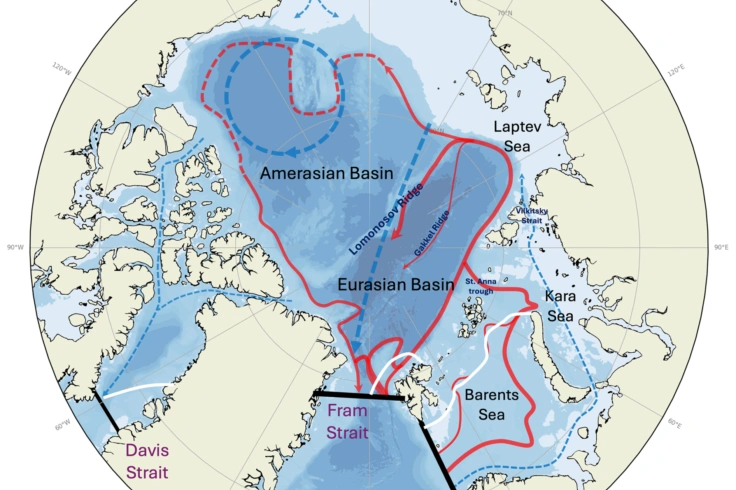
Polar oceans influence the Gulf Stream
The warm Gulf Stream is maintained by coldness. The Barents Sea is a cooling machine.

01.06.26
Mapping the world’s vanished glaciers
A global reconstruction of Ice Age mountain glaciers opens new doors for climate and ecosystem research.