Is Norway prepared for the future?
A new report raises questions about whether Norway is sufficiently prepared for the climate of the future—and what it will take to adapt in the best possible way.
Publisert 18. June 2026
Written by Thea Svensson
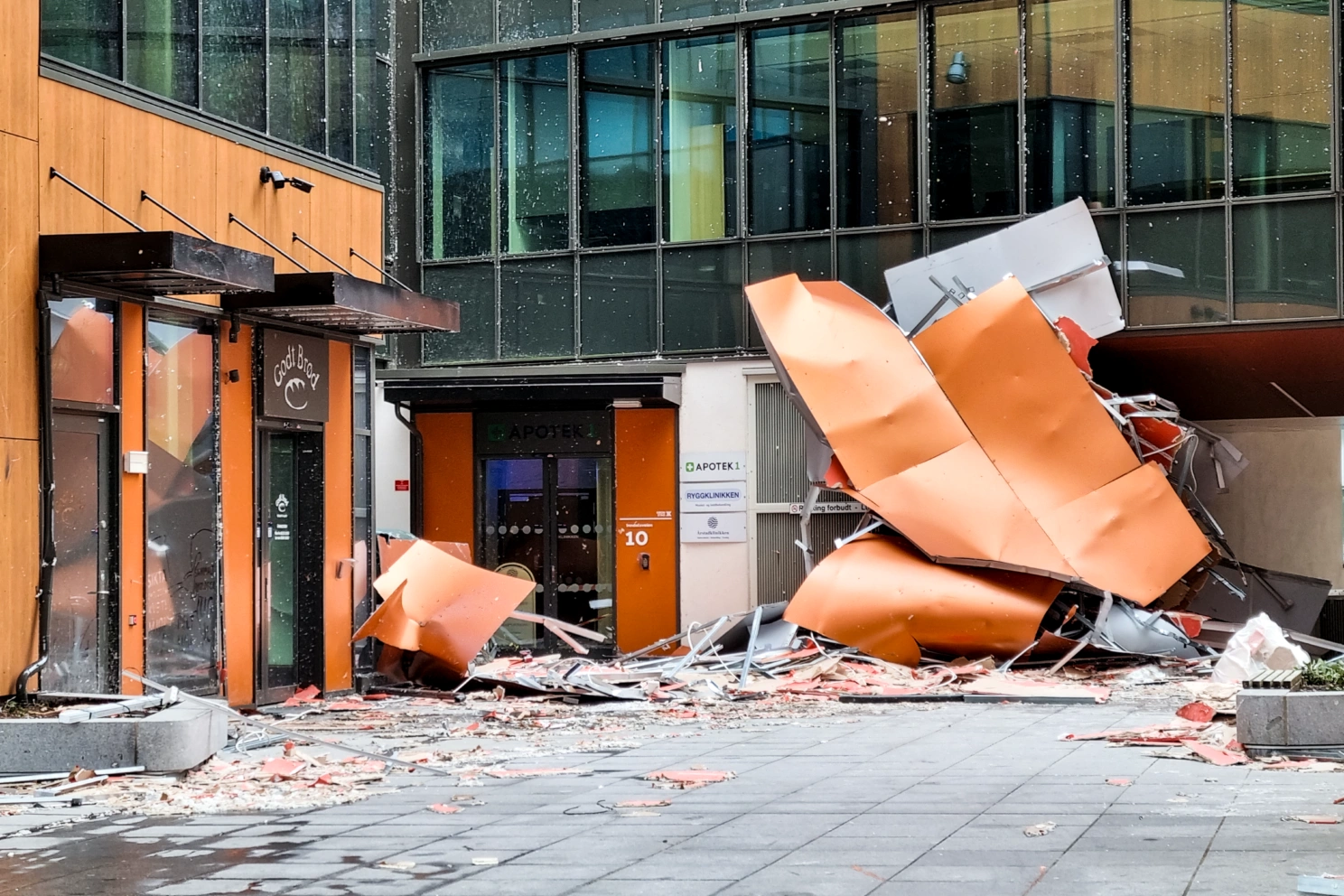
Destruction at Kronstad in Bergen after the storm Amy. Photo: Ellen Viste
The Expert Committee on Climate Adaptation
In June 2023, the government announced that an expert committee would be appointed to increase knowledge about the socio-economic consequences of climate change for vulnerable sectors and regions in Norway. At the same time, they were tasked with identifying priority areas where the potential to reduce climate-related risk is high relative to the cost of measures.
The mandate was broad and covered many aspects of the climate crisis, from assessing risks facing different regions to identifying potential measures and barriers.
In its work, the committee maintained close dialogue with and involvement of affected stakeholders: public agencies, the municipal sector, the Sámi Parliament, the Norwegian Reindeer Herders’ Association, independent experts, organizations, and the business sector.
Read the full report here: https://www.regjeringen.no/no/dokumenter/norge-i-hardt-var/id3166099/
Read the mandate here: https://nettsteder.regjeringen.no/klimatilpasning/mandat/
Three years ago, the storm “Hans” caused major destruction in Norway. One of the places affected was Nesbyen in Hallingdal.
- I am from Nesbyen myself, so I know people there, says Professor Asgeir Sorteberg from the Geophysical Institute at the University of Bergen and the Bjerknes Centre for Climate Research.
As part of the government-appointed expert committee on climate adaptation, Sorteberg has travelled around Norway to gather knowledge about how municipalities handle extreme weather.
- There are still people who have not been able to move back into their homes, and who do not know whether they can rebuild on the same plot—even after nearly three years, says Sorteberg.
Asgeir Sorteberg. Photo: Ellen Viste
The story from Nesbyen is not unique—many small municipalities experience major damage without having sufficient expertise or support to handle the situation.
- When the flooding was happening and people had to be evacuated, there was plenty of help available, says Sorteberg,
- But when the storm is over and everything needs to be rebuilt, you suddenly stand there alone. For municipalities facing this, there are no clear systems for where to turn.
Norway is a small, weather-exposed country with an open economy that is highly dependent on imports. Climate change will lead to more extreme weather in the years to come, and the consequences will be felt both domestically and internationally.
The expert committee has now published a report outlining the main challenges related to climate adaptation, while also pointing to necessary measures and barriers.
Climate adaptation in the dark
The report highlights a complex problem: lack of knowledge, unclear division of responsibilities, and political incentives that favour short-term thinking over long-term preparedness.
- No one currently has an overview of climate-related costs, says Sorteberg.
- Without such an overview, it also becomes difficult to know what should be prioritized.
A consistent finding is that Norway lacks data on what climate change actually costs—both today and in the future.
- If you do not have an overview of the costs, it is obviously very difficult to carry out a cost-benefit analysis, Sorteberg explains.
- There are many costs and benefits we have not been able to put a price on, simply because the information does not exist.
This means that decision-makers cannot rely on a solid professional basis when working on climate adaptation. The result is a policy where measures are either postponed or implemented without knowing whether they are economically beneficial.
The problem goes beyond economics. Many consequences, such as loss of nature and social effects, are difficult to quantify.
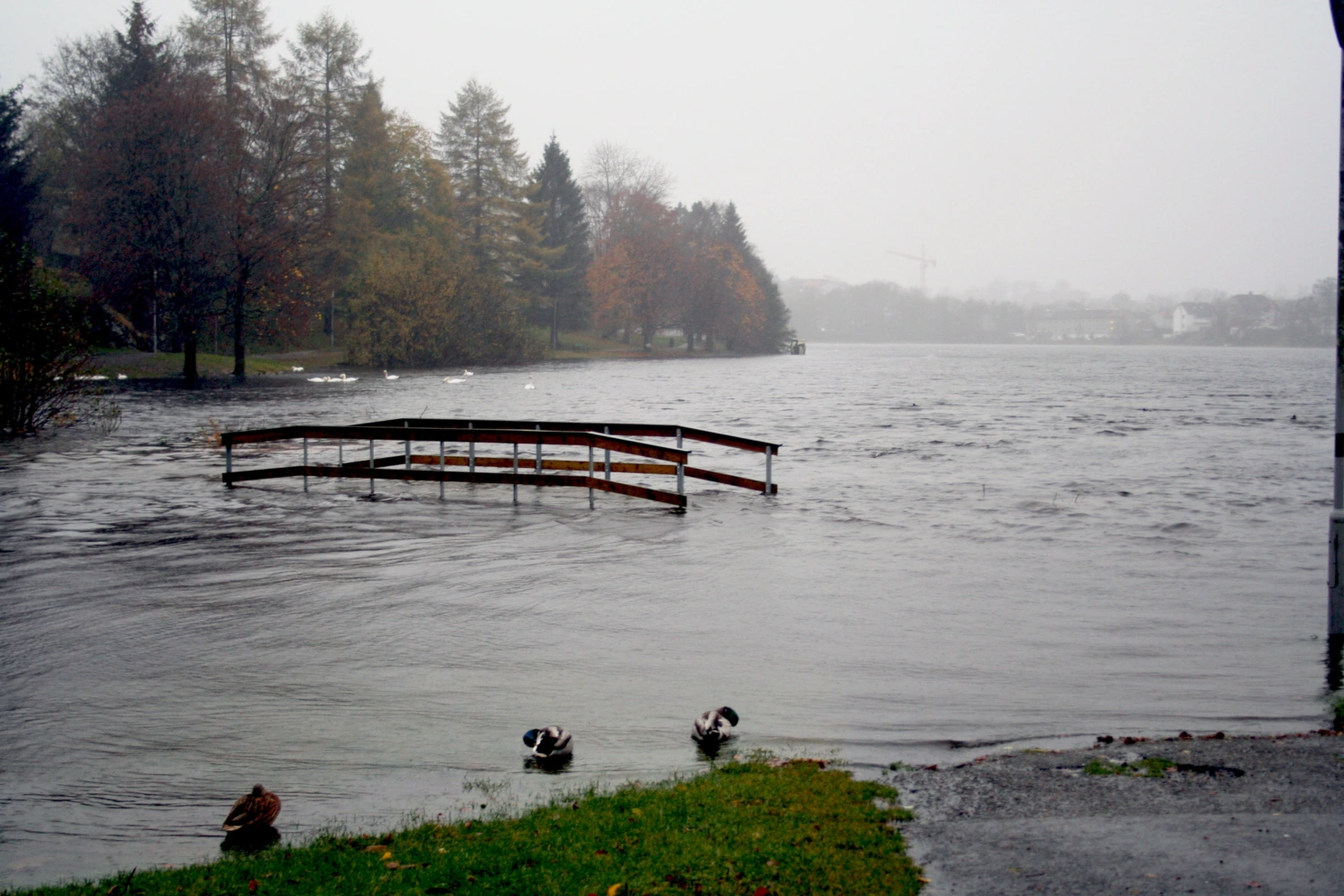
Flooding in Bergen after the storm Jacob. Photo: Tori Pedersen
Nature is losing its ability to adapt
Land-use policy is highlighted as a core challenge in the report. Local development decisions can have major consequences for nature’s ability to deal with climate change.
- Nature adapts itself, says Sorteberg.
- If it becomes too warm in an ecosystem, many species can simply move further north—but only if they have the opportunity.
Land management in Norway is largely delegated to the local level, where municipalities control land use under the Planning and Building Act. Most of Norway’s land area falls under this law, while a smaller portion is protected in various ways.
This means that whether nature is developed or protected depends on individual municipalities and local authorities, which cooperate to a limited extent on conservation and land management.
- Municipalities only see their own needs, and no one is really taking responsibility for seeing the nation’s needs, says Sorteberg.
But nature does not care about municipal borders. When nature is degraded in one municipality, its ability to adapt is weakened even in areas that extend beyond that municipality.
Decentralization makes it difficult to view environmental impacts in context and to safeguard common interests. Municipalities often have economic incentives to prioritize jobs and local value creation, while the costs of environmental damage are borne by society as a whole.
Barriers to climate adaptation
The report describes “soft” and “hard” limits to adaptation. Soft limits mean adaptation is possible but hindered by barriers. Hard limits mean there are clear technical or natural constraints on what can be adapted.
One such limit is institutional barriers—such as short-term decision-making, unclear responsibility, conflicting goals, hidden benefits, and administrative boundaries.
- The biggest barrier is that the cost of a climate adaptation measure is paid today, while the benefit comes later, says Sorteberg.
This makes climate adaptation politically difficult to prioritize. Climate change consequences increase over time, so measures should be implemented early—especially in new construction and upgrades to buildings and infrastructure with long lifespans, such as water and wastewater systems.
When investments must be made now but benefits come later, this can lead to delays. This may result in higher costs for damage and repairs in the future and less efficient use of resources.
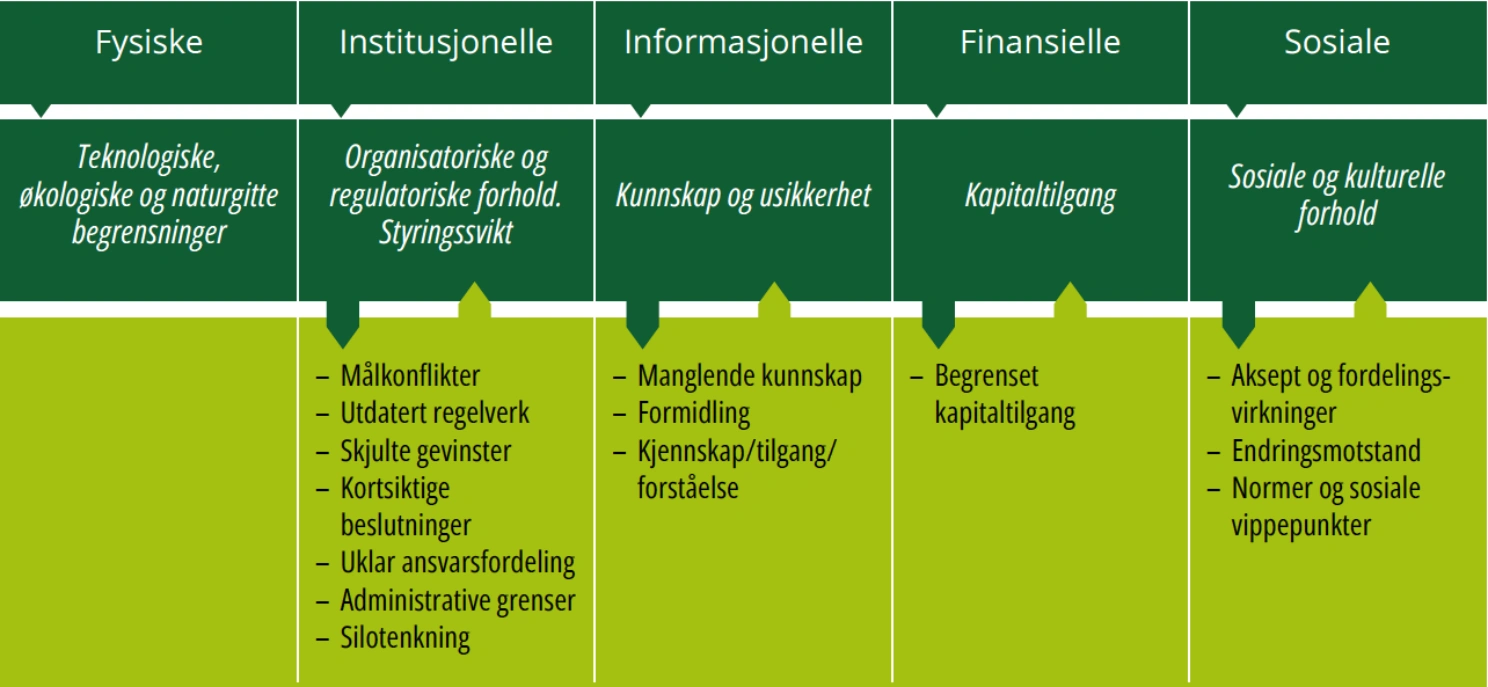
Figure taken from the report. The figure shows an overview of the different limits for climate adaptation. Ekspertutvalget om klimatilpasning. (2026). Norge i hardt vær [Review of Norge i hardt vær]. Source: https://www.regjeringen.no/no/aktuelt/okonomiske-konsekvenser-av-klimaendringene/id3166536/
Economic consequences
Climate change will require major adjustments in Norwegian industries, especially fisheries. Climate change may cause fish stocks to decrease or shift location. When fish become less available or more unpredictable, fishing vessels often have to travel farther, use more fuel, and spend more time. This increases costs and can reduce profitability.
The report identifies salmon lice as the most important environmental challenge for both farmed and wild salmon. Rising sea temperatures will exacerbate existing problems in aquaculture related to emissions and the spread of salmon lice.
- We see in fish farms that salmon lice thrive in warm water, says Sorteberg.
However, climate change will not only have negative effects. A positive consequence could be increased energy production, for example from hydropower. Estimates show that average annual hydropower production could increase by 1–1.8% by mid-century and 0.9–2.8% by the end of the century, depending on the climate scenario.
Although the committee focused on consequences and policy instruments in Norway, Sorteberg emphasizes that the largest economic impacts may come from abroad.
- What is likely much bigger than everything we have looked at is the effect of climate change abroad on prices in Norway, says Sorteberg.
- If less grain grows abroad, then there is less grain available for us to buy.
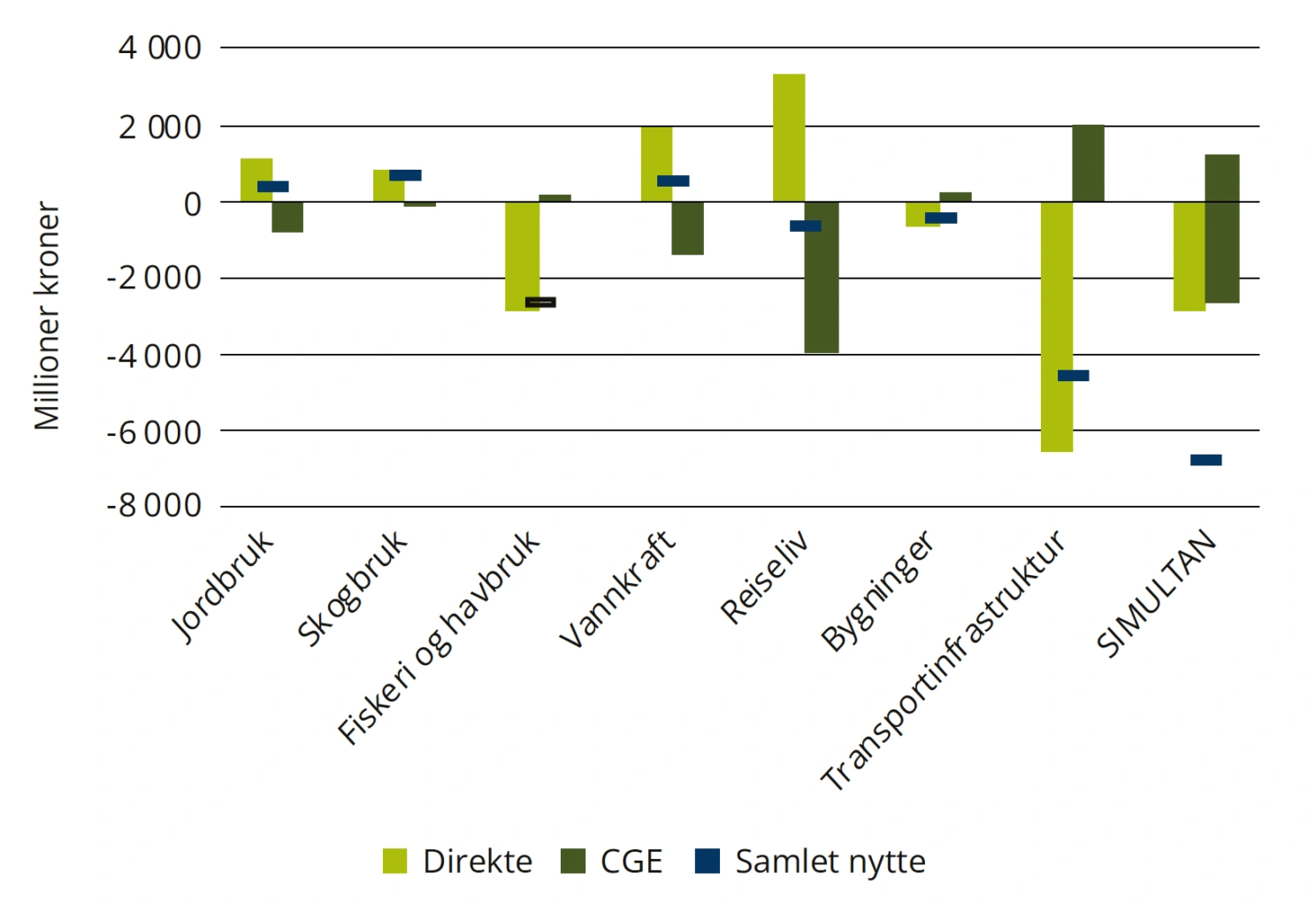
The figure shows how both direct climate impacts and interaction effects affect total utility in the high scenario in the middle of the century, distributed across the different areas of society and combined in a simultaneous simulation. The direct climate impacts come from the direct climate impacts that are entered into the model, while the interaction effects amplify or dampen these effects depending on how the actors adapt and existing price differences in the economy. Direct effects, CGE effects and total utility effects in the high scenario in 2050, individual categories and simultaneous simulation.
Ekspertutvalget om klimatilpasning. (2026). Norge i hardt vær [Review of Norge i hardt vær]. Source: https://www.regjeringen.no/no/aktuelt/okonomiske-konsekvenser-av-klimaendringene/id3166536/
Municipalities have the responsibility—but not the resources
Climate adaptation largely takes place at the local level, but municipalities responsible for this work often lack sufficient capacity.
- Half of Norway’s municipalities have fewer than 5,000 inhabitants, explains Sorteberg.
- The problem is that when municipalities are so small, it is difficult to build sufficient expertise.
At the same time, municipalities are expected to handle increasingly complex challenges, creating a clear gap between responsibility and capacity.
- Everything has, in a way, been pushed down to the municipal level, Sorteberg continues.
- The result is a system where implementation depends on random local capacity rather than a coherent national strategy.
Climate adaptation is not primarily about technology or knowledge alone, but about how society organizes itself. When the knowledge base is weak, responsibilities are unclear, and incentives are short-term, the result is a system that reacts to crises but does not prevent them.
For Norway to succeed better with climate adaptation, it requires not only more measures but also changes in how decisions are made, how responsibilities are distributed, and how long-term considerations are weighted, the report concludes.
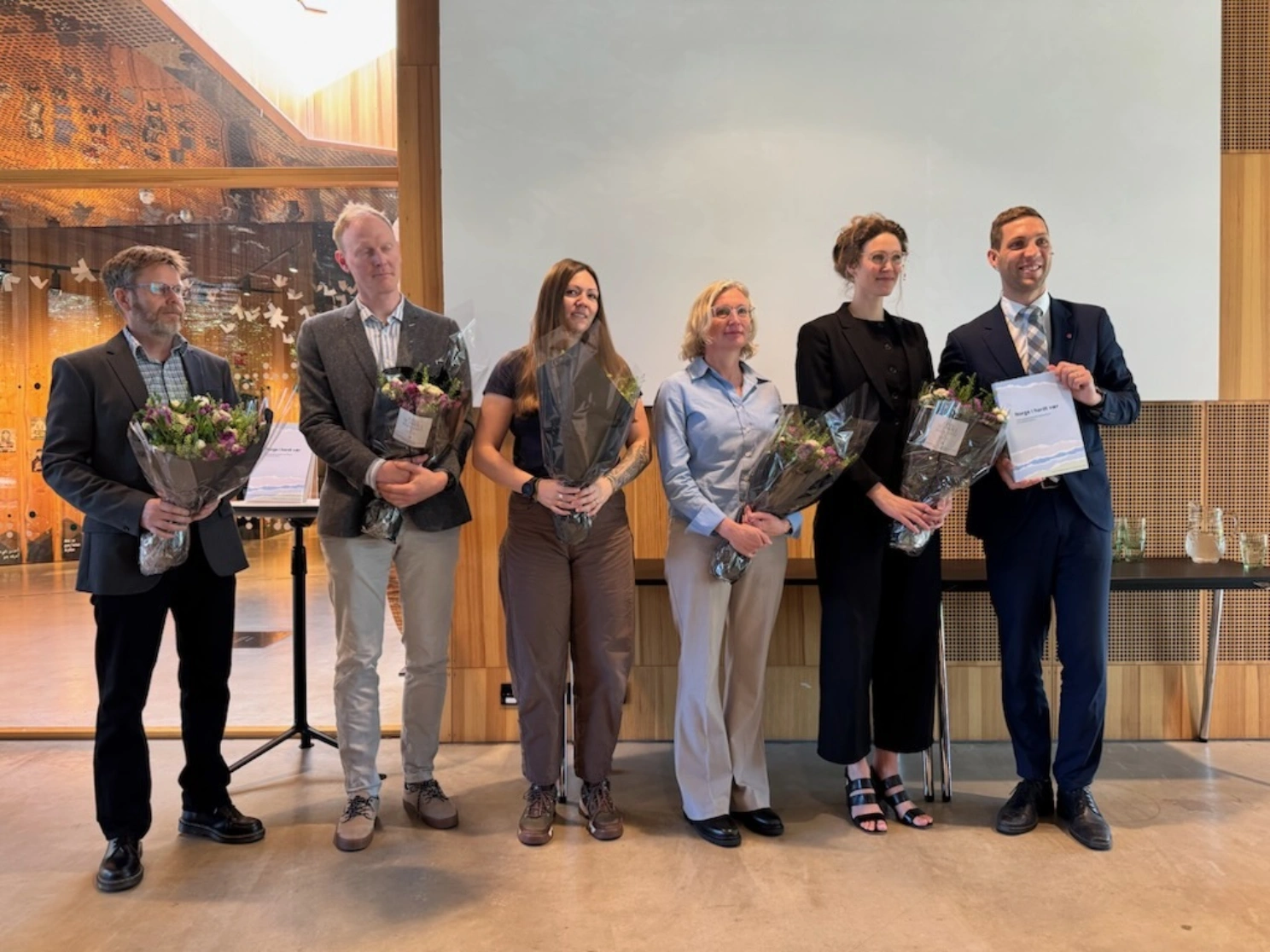
On June 18, 2026, the report was handed over to the Minister of Climate and Environment, Andreas Bjelland Eriksen. The picture shows the expert committee together with the Minister of Climate during the handover. Photo: Nora V. Traaholt.