Hopp til hovedinnhold

Kalender

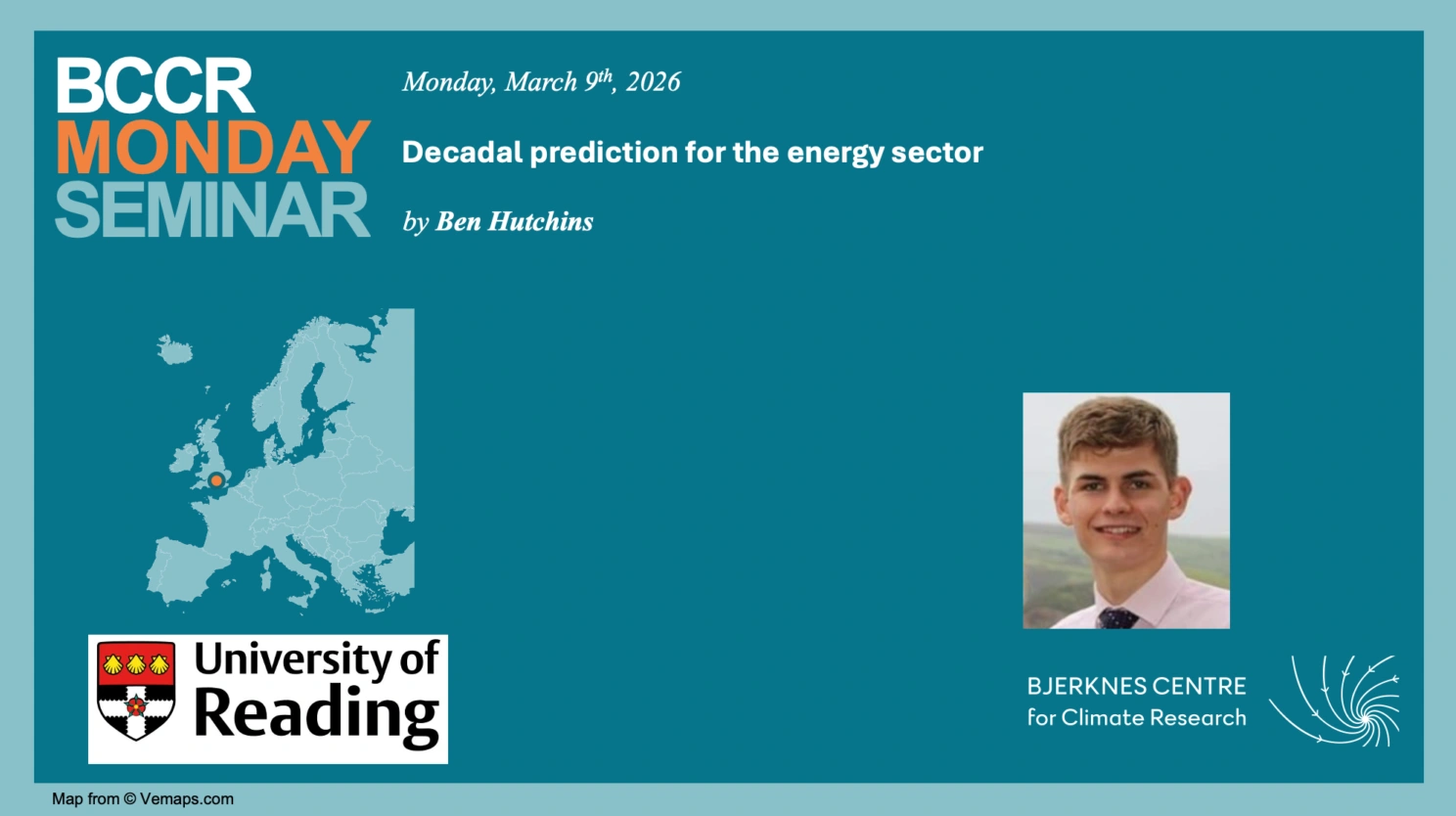
BCCR Monday Seminar: “Decadal prediction for the energy sector”
Tidspunkt

09. mars 2026, 10:00-11:00

Sted

BCCR Seminar Room 4020, Jahnebakken 5

Dear all,


The next BCCR Monday Seminar will be given by Ben Hutchins from the University of Reading. He will present his work on “Decadal prediction for the energy sector”. 

The seminar will take place in the usual BCCR seminar room (4th floor of the West wing) at 11:00.


We hope to see you there!


Best regards,


Fiona and Johannes

  
Abstract

The timescale of decadal climate predictions, from a year-ahead up to a decade, is an important planning horizon for stakeholders in the energy sector. With power systems transitioning towards a greater share of renewables, these systems become more vulnerable to the impacts of both climate variability and climate change. As decadal predictions sample both the internal variability of the climate and the externally forced response, these forecasts can provide useful information for the upcoming decade.
There are two main ways in which decadal predictions can benefit the energy sector. Firstly, they can be used to try to predict how a variable of interest, such as average temperature, may evolve over the coming year or decade. Secondly, a large ensemble of decadal predictions can be aggregated into a large synthetic event set to explore physically plausible extremes, such as winter wind droughts.

We find predictive skill at decadal timescales for surface variables over Europe during both winter (ONDJFM) and summer (AMJJAS). Although this skill is patchy, there are regions of relevance to the energy sector, such as over the UK for temperature, where this skill emerges. We find significant skill when using pattern-based (e.g., NAO) approaches to make predictions of European energy indicators during the extended winter, including Northern Europe offshore wind generation, Spanish solar generation, and Scandinavian precipitation. Our results highlight the potential for operational decadal predictions for the energy system, with potential benefits for both the planning and operation of the future power system.


Speaker information

Ben is a PhD student at the University of Reading, exploring the applications of decadal forecasts for the energy sector. He is currently working as a Research Scientist for the National Centre for Atmospheric Science on the WISTERIA project, exploring the prediction skill for wind speed over Asia. Ben has previously worked part-time for the Royal Meteorological Society as their Science Engagement Fellow for Energy and has worked on the development of the annual 'State of the Climate for the UK Energy Sector' report.
Flere kalenderoppføringer

Se alle
Illustrasjonsbilde
22.06.26

BCCR Seminar: Lotta Thaller – Regional Integrated Assessment of Ocean Alkalinity Enhancement: A Case Study for Norway

Abstract Achieving Norway’s 2050 climate target will likely require large-scale carbon dioxide removal (CDR) to offset residual emissions. As interest in marine CDR grows, robust regional assessments are needed to evaluate its role in Norway’s climate mitigation portfolio. Ocean Alkalinity Enhancement (OAE) is a promising approach, but its CO2-removal efficiency, environmental impacts, and economic viability remain poorly constrained at regional scales. We present a coupled biogeochemical-economic framework to quantify the CO2-removal potential, carbonate-system impacts, and techno-economics of slaked-lime (Ca(OH)2) addition in the Norwegian Sea, focusing on a region centred on Ocean Weather Station M. A seasonally resolved two-box carbonate-system model, including air–sea gas exchange, biological carbon cycling, vertical mixing, and convective overturning, is solved with PyCO2SYS and forced by observational climatologies and NorESM2-LM climate-change signals under SSP1-2.6, SSP2-4.5, and SSP5-8.5. Simulated deployment occurs from 2030 to 2050. Additional CO2 uptake is coupled to a regional integrated assessment model that accounts for lime supply-chain costs and emissions, enabling estimates of net removals, cost curves, and break-even carbon prices relative to the EU ETS, Norwegian carbon tax, and voluntary carbon markets. Across deployment rates of 50-350 kt month-1, gross removal efficiency is 0.81-0.84 tCO2 per t Ca(OH)2, increasing under higher-emission scenarios and declining slightly with dose. Supply-chain emissions reduce net removals by 9-13%. OAE lowers surface-ocean pCO2 by up to ~75 µatm and increases surface pH (up to +0.07) and calcite saturation state (up to +0.5) during deployment. However, these effects remain largely confined to surface waters and dissipate after deployment ceases, with minimal changes in the deep ocean. Break-even costs of ~270-290 USD tCO2-1 exceed current EU ETS and Norwegian carbon-tax levels, rendering offshore OAE economically unattractive under present policy conditions. While OAE could contribute to Norway’s future CDR portfolio, large-scale deployment will require stronger policy support. Speaker information Lotta Thaller is a doctoral candidate at Kiel University and a researcher in the Global Commons and Climate Policy group at the Kiel Institute for the World Economy. Her research focuses on the economics and governance of carbon dioxide removal (CDR), combining climate-economic modelling with policy analysis to assess the role of CDR technologies in climate change mitigation. Within the Horizon Europe project SEAO2-CDR, she investigates how marine CDR can be represented in Integrated Assessment Models. She studied Economics at the University of Hamburg and holds a Master's degree in Environmental and Resource Economics from Kiel University. Her recent work has examined demand and supply for CDR and contributed to research on country-level social cost of carbon estimates and the valuation of natural carbon sinks
Illustrasjonsbilde
23.06.26

Global theme meeting