Calendar
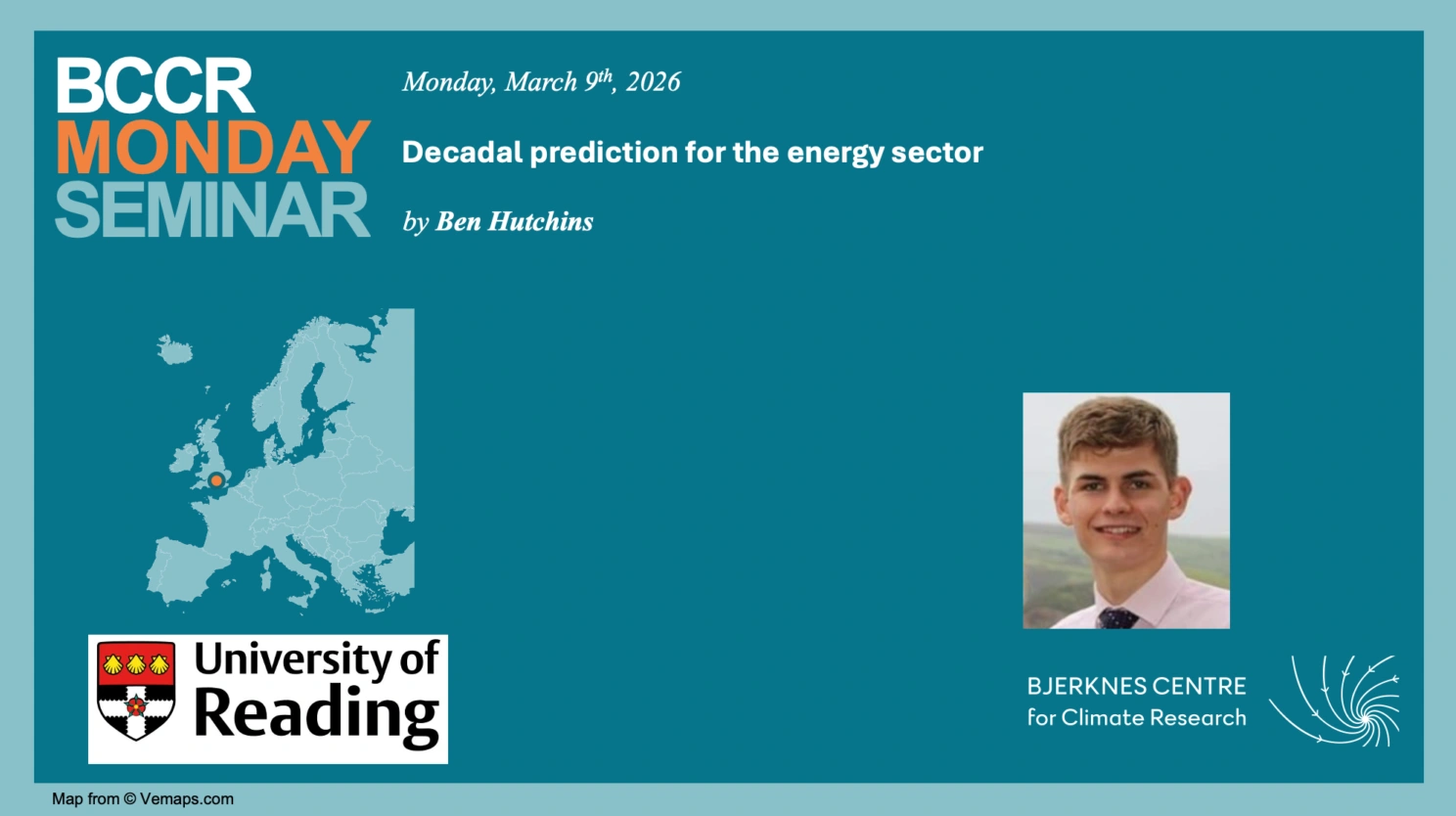
BCCR Monday Seminar: “Decadal prediction for the energy sector”
Time
09. March 2026, 10:00-11:00
Location
BCCR Seminar Room 4020, Jahnebakken 5
Dear all,
The next BCCR Monday Seminar will be given by Ben Hutchins from the University of Reading. He will present his work on “Decadal prediction for the energy sector”.
The seminar will take place in the usual BCCR seminar room (4th floor of the West wing) at 11:00.
We hope to see you there!
Best regards,
Fiona and Johannes
Abstract
The timescale of decadal climate predictions, from a year-ahead up to a decade, is an important planning horizon for stakeholders in the energy sector. With power systems transitioning towards a greater share of renewables, these systems become more vulnerable to the impacts of both climate variability and climate change. As decadal predictions sample both the internal variability of the climate and the externally forced response, these forecasts can provide useful information for the upcoming decade.
There are two main ways in which decadal predictions can benefit the energy sector. Firstly, they can be used to try to predict how a variable of interest, such as average temperature, may evolve over the coming year or decade. Secondly, a large ensemble of decadal predictions can be aggregated into a large synthetic event set to explore physically plausible extremes, such as winter wind droughts.
We find predictive skill at decadal timescales for surface variables over Europe during both winter (ONDJFM) and summer (AMJJAS). Although this skill is patchy, there are regions of relevance to the energy sector, such as over the UK for temperature, where this skill emerges. We find significant skill when using pattern-based (e.g., NAO) approaches to make predictions of European energy indicators during the extended winter, including Northern Europe offshore wind generation, Spanish solar generation, and Scandinavian precipitation. Our results highlight the potential for operational decadal predictions for the energy system, with potential benefits for both the planning and operation of the future power system.
Speaker information
Ben is a PhD student at the University of Reading, exploring the applications of decadal forecasts for the energy sector. He is currently working as a Research Scientist for the National Centre for Atmospheric Science on the WISTERIA project, exploring the prediction skill for wind speed over Asia. Ben has previously worked part-time for the Royal Meteorological Society as their Science Engagement Fellow for Energy and has worked on the development of the annual 'State of the Climate for the UK Energy Sector' report.
More events
See all
Stormtrack group meeting
