Kalender
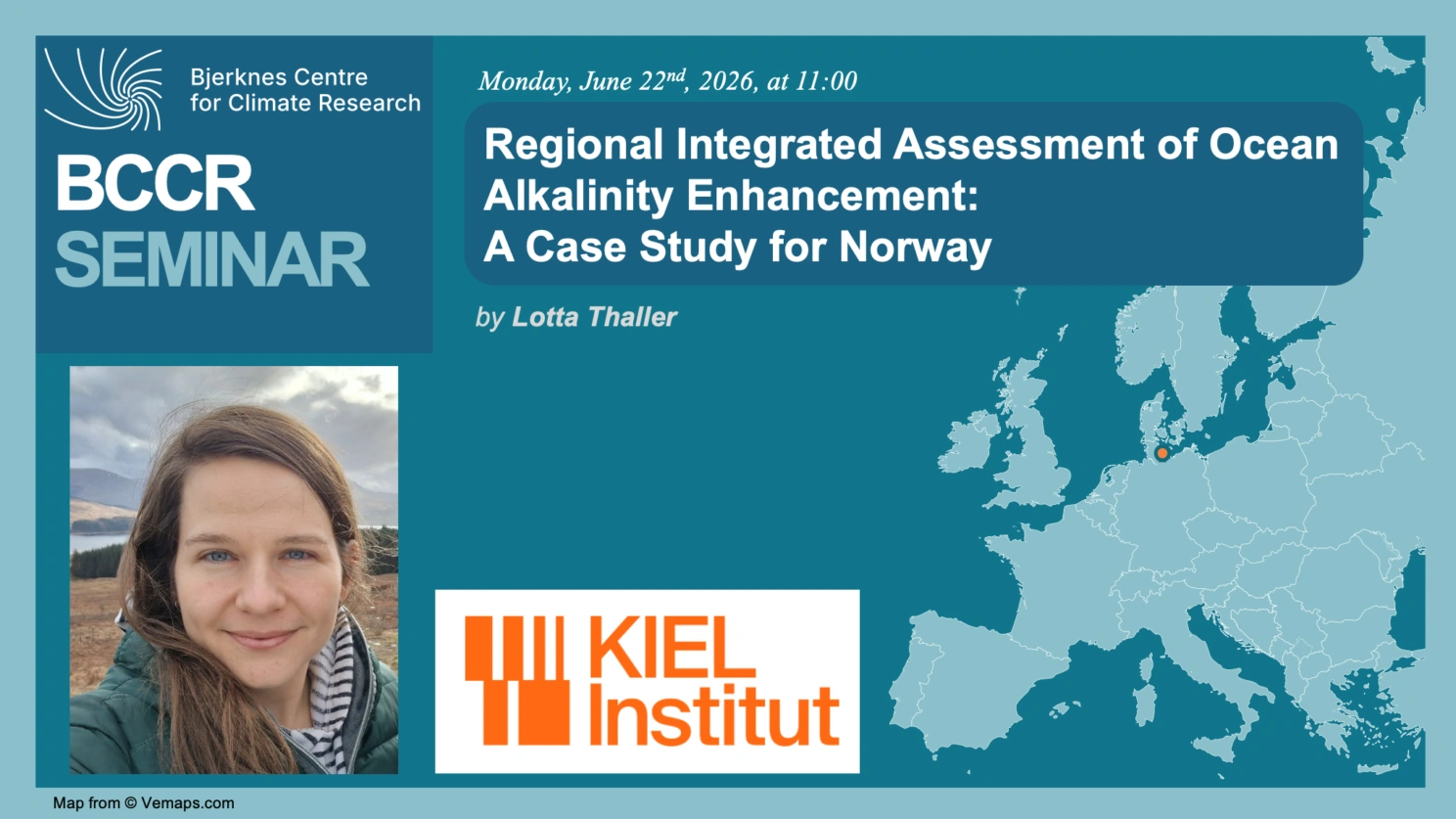
BCCR Seminar: Lotta Thaller – Regional Integrated Assessment of Ocean Alkalinity Enhancement: A Case Study for Norway

Tidspunkt
22. juni 2026, 09:00-10:00
Sted
BCCR lecture room 4020, Jahnebakken 5
Abstract
Achieving Norway’s 2050 climate target will likely require large-scale carbon dioxide removal (CDR) to offset residual emissions. As interest in marine CDR grows, robust regional assessments are needed to evaluate its role in Norway’s climate mitigation portfolio. Ocean Alkalinity Enhancement (OAE) is a promising approach, but its CO2-removal efficiency, environmental impacts, and economic viability remain poorly constrained at regional scales.
We present a coupled biogeochemical-economic framework to quantify the CO2-removal potential, carbonate-system impacts, and techno-economics of slaked-lime (Ca(OH)2) addition in the Norwegian Sea, focusing on a region centred on Ocean Weather Station M. A seasonally resolved two-box carbonate-system model, including air–sea gas exchange, biological carbon cycling, vertical mixing, and convective overturning, is solved with PyCO2SYS and forced by observational climatologies and NorESM2-LM climate-change signals under SSP1-2.6, SSP2-4.5, and SSP5-8.5. Simulated deployment occurs from 2030 to 2050.
Additional CO2 uptake is coupled to a regional integrated assessment model that accounts for lime supply-chain costs and emissions, enabling estimates of net removals, cost curves, and break-even carbon prices relative to the EU ETS, Norwegian carbon tax, and voluntary carbon markets. Across deployment rates of 50-350 kt month-1, gross removal efficiency is 0.81-0.84 tCO2 per t Ca(OH)2, increasing under higher-emission scenarios and declining slightly with dose. Supply-chain emissions reduce net removals by 9-13%.
OAE lowers surface-ocean pCO2 by up to ~75 µatm and increases surface pH (up to +0.07) and calcite saturation state (up to +0.5) during deployment. However, these effects remain largely confined to surface waters and dissipate after deployment ceases, with minimal changes in the deep ocean. Break-even costs of ~270-290 USD tCO2-1 exceed current EU ETS and Norwegian carbon-tax levels, rendering offshore OAE economically unattractive under present policy conditions. While OAE could contribute to Norway’s future CDR portfolio, large-scale deployment will require stronger policy support.
Speaker information
Lotta Thaller is a doctoral candidate at Kiel University and a researcher in the Global Commons and Climate Policy group at the Kiel Institute for the World Economy. Her research focuses on the economics and governance of carbon dioxide removal (CDR), combining climate-economic modelling with policy analysis to assess the role of CDR technologies in climate change mitigation. Within the Horizon Europe project SEAO2-CDR, she investigates how marine CDR can be represented in Integrated Assessment Models.
She studied Economics at the University of Hamburg and holds a Master's degree in Environmental and Resource Economics from Kiel University. Her recent work has examined demand and supply for CDR and contributed to research on country-level social cost of carbon estimates and the valuation of natural carbon sinks
Flere kalenderoppføringer
Se alle
Prøveforelesning over oppgitt emne for ph.d.-graden - MSc.- Jarle Børve Sleire