Hopp til hovedinnhold

Kalender

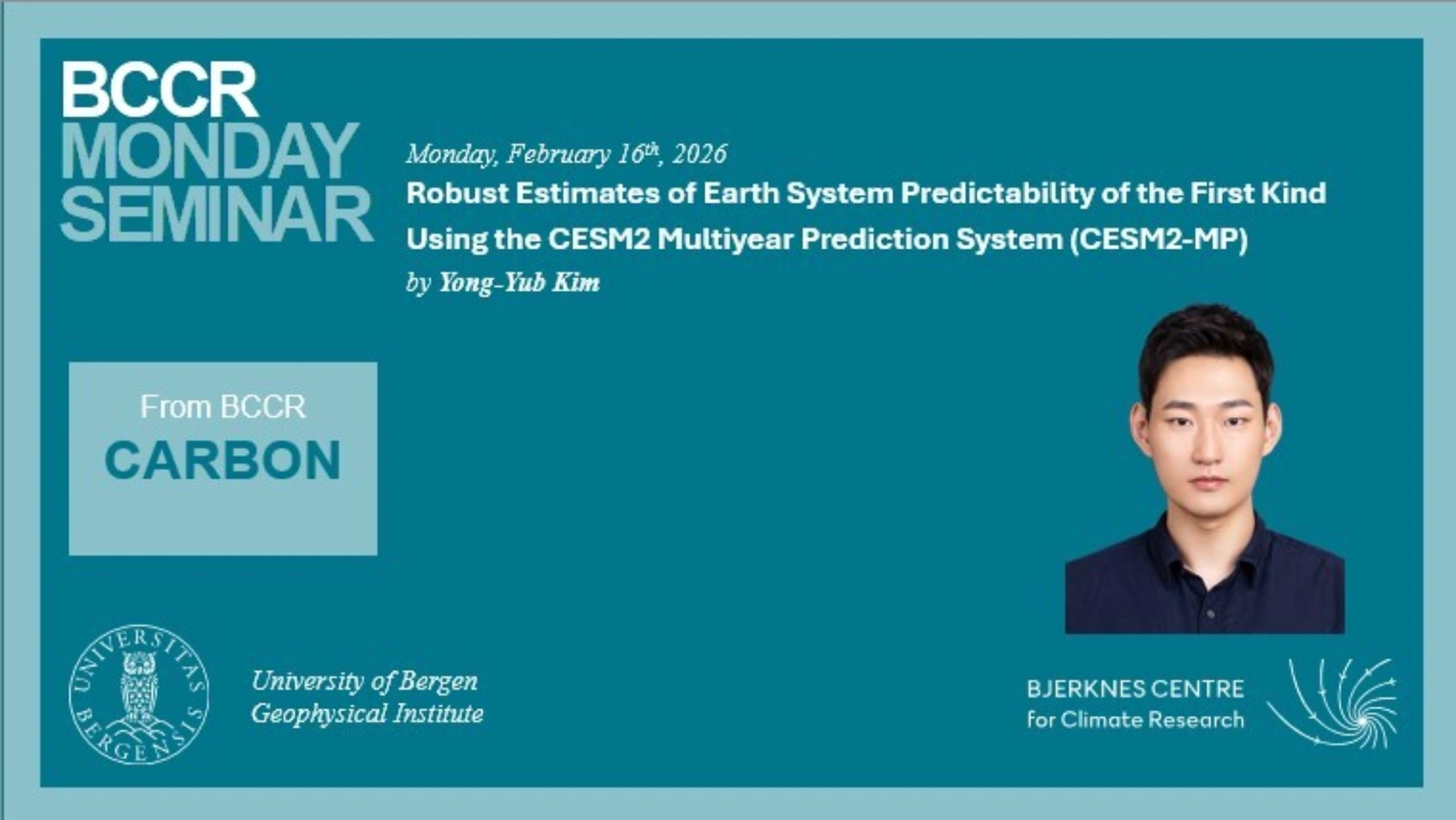
BCCR Monday Seminar: Robust Estimates of Earth System Predictability of the First Kind Using the CESM2 Multiyear Prediction System (CESM2-MP)

Tidspunkt

16. februar 2026, 10:00-11:00

Sted

Bjerknes lecture room 4020

Abstract

Here, we present a new seasonal-to-multiyear Earth prediction system, Community Earth System Model, version 2, multiyear prediction system (CESM2-MP), based on the CESM2. A 20-member ensemble that assimilates oceanic temperature and salinity anomalies provides the initial conditions for 5-yr predictions from 1960 to 2020. We analyze skills using pairwise ensemble statistics, calculated among individual members (IMs), and compare the results with those obtained from the more commonly used ensemble-mean (EM) approach. This comparison is motivated by the fact that an EM of a nonlinear dynamical system generates, unlike reality, a heavily smoothed trajectory, akin to the evolution of a slow manifold. However, for most autonomous nonlinear systems, the EM does not even represent a solution of the underlying physical equations, and it should therefore not be used as an estimate of the expected trajectory. The IM-based approach is less sensitive to ensemble size than EM-based skill computations, and its estimates of attainable prediction skills are closer to the actual skills. Using IM-based statistics helps to unravel the physics of predicted patterns in the CESM2-MP and their relationship to ocean–atmosphere–land interactions and climate modes of variability. Furthermore, the IM-based method emphasizes predictability of the first kind, which is associated with initial error sensitivity. In contrast, the EM-based method is more sensitive to the predictability of the second kind, which is associated with the external forcing and time-varying boundary conditions. Calculating IM-based skills for the CESM2-MP provides new insights into the sources of predictability originating from ocean initial conditions, helping to delineate and quantify the forecast limits of internal climate variability.


Speaker information

Yong-Yub is a new postdoctoral researcher at the Geophysical Institute at the University of Bergen. His research focuses on multiyear-to-centennial changes in marine biogeochemistry, the predictability of biogeochemical processes, and potential tipping points in the ocean system.

He completed his PhD in Physical Oceanography at Seoul National University, where he used the ROMS regional ocean model to investigate future environmental changes in the East Asian marginal seas. He subsequently worked at the IBS Center for Climate Physics (ICCP), where he developed a multiyear prediction system based on CESM2 (CESM2-MP).
Flere kalenderoppføringer

Se alle

Illustrasjonsbilde
09.03.26

BCCR Monday Seminar: “Decadal prediction for the energy sector”

Dear all, The next BCCR Monday Seminar will be given by Ben Hutchins from the University of Reading. He will present his work on “Decadal prediction for the energy sector”. The seminar will take place in the usual BCCR seminar room (4th floor of the West wing) at 11:00. We hope to see you there! Best regards, Fiona and Johannes Abstract The timescale of decadal climate predictions, from a year-ahead up to a decade, is an important planning horizon for stakeholders in the energy sector. With power systems transitioning towards a greater share of renewables, these systems become more vulnerable to the impacts of both climate variability and climate change. As decadal predictions sample both the internal variability of the climate and the externally forced response, these forecasts can provide useful information for the upcoming decade. There are two main ways in which decadal predictions can benefit the energy sector. Firstly, they can be used to try to predict how a variable of interest, such as average temperature, may evolve over the coming year or decade. Secondly, a large ensemble of decadal predictions can be aggregated into a large synthetic event set to explore physically plausible extremes, such as winter wind droughts. We find predictive skill at decadal timescales for surface variables over Europe during both winter (ONDJFM) and summer (AMJJAS). Although this skill is patchy, there are regions of relevance to the energy sector, such as over the UK for temperature, where this skill emerges. We find significant skill when using pattern-based (e.g., NAO) approaches to make predictions of European energy indicators during the extended winter, including Northern Europe offshore wind generation, Spanish solar generation, and Scandinavian precipitation. Our results highlight the potential for operational decadal predictions for the energy system, with potential benefits for both the planning and operation of the future power system. Speaker information Ben is a PhD student at the University of Reading, exploring the applications of decadal forecasts for the energy sector. He is currently working as a Research Scientist for the National Centre for Atmospheric Science on the WISTERIA project, exploring the prediction skill for wind speed over Asia. Ben has previously worked part-time for the Royal Meteorological Society as their Science Engagement Fellow for Energy and has worked on the development of the annual 'State of the Climate for the UK Energy Sector' report.
Illustrasjonsbilde
04.03.26

Stormtracks Group Meeting

We’ll have our Stormtracks group meeting this Wednesday (04.03) from 14:00 to 15:00 at Skybar (BCCR 3180). This week Sigrid Galtvik will give a talk on Frontogenesis of stationary and propagating vortices. The meeting will be hybrid and you can join remotely via Zoom: https://uib.zoom.us/j/62886269543?pwd=ajWbi97zr0hbniaoQdZkUtD2EUSSri.1 Meeting ID: 628 8626 9543 | Password: qSKTfKU3 The meeting schedule for this semester is in the following google doc and there are still open spots! Any ongoing results are also very welcomed and encouraged just add your name directly to the schedule: https://docs.google.com/document/d/1F9hy45DSeS9qrXl-3l4cNzCPSE9OuBBVqdCu3VY240U/edit?usp=sharing See you all there! :) Cheers, Birgit and Yangfan