Hopp til hovedinnhold

Kalender

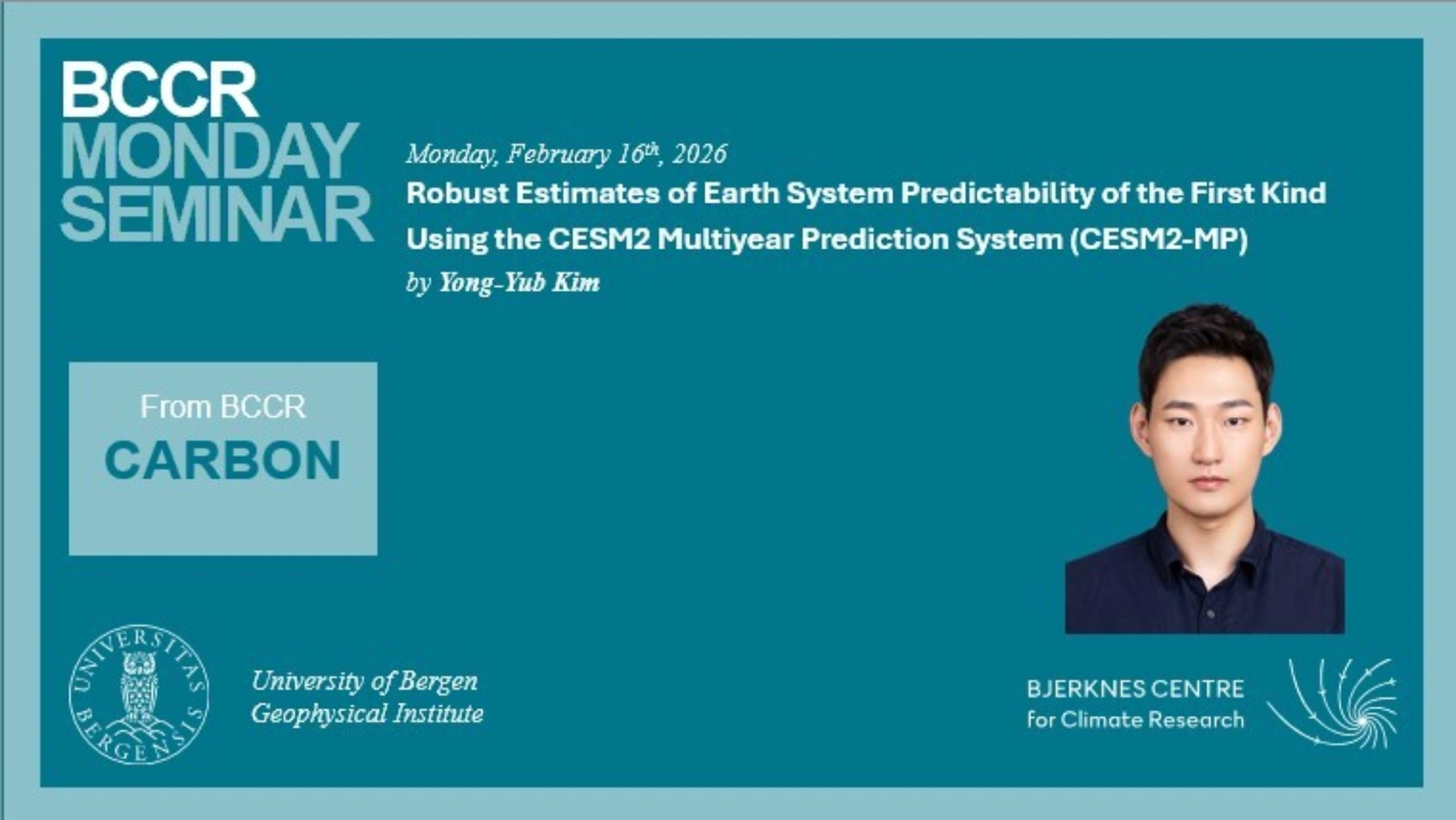
BCCR Monday Seminar: Robust Estimates of Earth System Predictability of the First Kind Using the CESM2 Multiyear Prediction System (CESM2-MP)

Tidspunkt

16. februar 2026, 10:00-11:00

Sted

Bjerknes lecture room 4020

Abstract

Here, we present a new seasonal-to-multiyear Earth prediction system, Community Earth System Model, version 2, multiyear prediction system (CESM2-MP), based on the CESM2. A 20-member ensemble that assimilates oceanic temperature and salinity anomalies provides the initial conditions for 5-yr predictions from 1960 to 2020. We analyze skills using pairwise ensemble statistics, calculated among individual members (IMs), and compare the results with those obtained from the more commonly used ensemble-mean (EM) approach. This comparison is motivated by the fact that an EM of a nonlinear dynamical system generates, unlike reality, a heavily smoothed trajectory, akin to the evolution of a slow manifold. However, for most autonomous nonlinear systems, the EM does not even represent a solution of the underlying physical equations, and it should therefore not be used as an estimate of the expected trajectory. The IM-based approach is less sensitive to ensemble size than EM-based skill computations, and its estimates of attainable prediction skills are closer to the actual skills. Using IM-based statistics helps to unravel the physics of predicted patterns in the CESM2-MP and their relationship to ocean–atmosphere–land interactions and climate modes of variability. Furthermore, the IM-based method emphasizes predictability of the first kind, which is associated with initial error sensitivity. In contrast, the EM-based method is more sensitive to the predictability of the second kind, which is associated with the external forcing and time-varying boundary conditions. Calculating IM-based skills for the CESM2-MP provides new insights into the sources of predictability originating from ocean initial conditions, helping to delineate and quantify the forecast limits of internal climate variability.


Speaker information

Yong-Yub is a new postdoctoral researcher at the Geophysical Institute at the University of Bergen. His research focuses on multiyear-to-centennial changes in marine biogeochemistry, the predictability of biogeochemical processes, and potential tipping points in the ocean system.

He completed his PhD in Physical Oceanography at Seoul National University, where he used the ROMS regional ocean model to investigate future environmental changes in the East Asian marginal seas. He subsequently worked at the IBS Center for Climate Physics (ICCP), where he developed a multiyear prediction system based on CESM2 (CESM2-MP).
Flere kalenderoppføringer

Se alle
Illustrasjonsbilde
19.05.26

Bjerknes Proposal Writing Workshop From idea to project: Writing successful project proposals

Bjerknes Proposal Writing Workshop 2026 From idea to project: Writing successful project proposals 19.05.2026: 9:00 – 16:00 20.05.2026: 9:00 – 15:30 Registration deadline: 24.04.2026 Link for registration: Bjerknes Proposal Writing Workshop 2026 – Fill out form Venue: UiB Læringsarena, Nygårdsgaten 5, Bergen Workshop leaders: Friederike U. Hoffmann, Research coordinator at GFI and EU expert evaluator; Nadine Goris, Researcher and Research Adviser at NORCE; Catherine Downy, Research Coordinator at NERSC Credit point: 1 (ECTS) Maximum number of participants: 15 For questions, please contact Friederike.Hoffmann@uib.no The target group is early career scientists (postdocs, early career researchers, PhDs) in climate sciences with little or no experience in proposal writing. The workshop targets both those who already have a concrete project idea and a plan to submit a proposal, and those who want to gain general proposal writing and project development skills. The workshop will enable you to apply for external funding for your own research. You will obtain the necessary skills through a mix of short lectures, group work, and plenary presentations, during which the research ideas of 3 participants will be developed into proposal concepts. You will learn about: the central elements of a project proposal how successful research proposals are developed, structured, and presented the most relevant funding opportunities for early career scientists You will learn how to: present a project idea briefly and concisely (pitching) develop the central components of a research proposal structure these components into a convincing project concept draft a project budget In case the workshop is overbooked, Bjerknes members and scientists with own project ideas will be prioritized. For PhD students: this workshop makes the most sense if you are in the 3rd (or 4th) year of your PhD. PhD students in their 1st or 2nd year will not be prioritized. References: General information about the workshop: Proposal writing training at Bjerknes Center Publication about the course concept: Proposal Writing Training and Idea Development for Early‐Career Researchers Based on Constructive Alignment, Co‐Creation and Active Learning Strategies - Hoffmann - 2025 - Ecology and Evolution - Wiley Online Library
Illustrasjonsbilde
16.03.26

Monday Seminar: Michael Spall - And then it sinks: ups and downs of the meridional overturning circulation

Abstract The global-scale meridional overturning circulation (MOC) plays an important role in the climate system by transporting heat, salt, nutrients, and other tracers across latitude circles. While waters are near the surface, air-sea fluxes exchange heat, water, carbon, and other tracers between the ocean and atmosphere, influencing weather and climate. Once removed from the surface, many of these tracers are nearly conserved following the flow, thus the MOC is an effective means to transport properties across global scales. Our understanding of the overturning circulation has developed in recent decades from both global and local perspectives. The focus of this talk will be on the local physics that concentrate vertical transports near boundaries, and non-local physics that connect surface forcing with those vertical transports. Idealized models, simple theories, and observations will be used to demonstrate these processes. Basic conservation principles are used to provide insight into the controlling physics and how the overturning in both depth space and density space depends on atmospheric forcing and environmental conditions. Speaker information BS, MS 1980, 1982, Mechanical Engineering, Clarkson College of Tech. PhD 1988, Applied Mathematics, Harvard University Visiting Scientist National Center for Atmospheric Research, 1988-1990 WHOI, 1990-present Scientific interests: Application of idealized numerical and theoretical calculations to understanding mean and low frequency variability of the general ocean circulation. Particular interests include marginal seas, mesoscale variability, Arctic Ocean. Join Zoom Meeting https://uib.zoom.us/j/68304284910?pwd=2IgsDMWHuJlQw3XFHSTo3OoGBsRrhz.1 Meeting ID: 683 0428 4910 Password: 7pwZK4mG