Hopp til hovedinnhold

Kalender

BCCR X-theme Seminar: AMOC

Tidspunkt

02. februar 2026, 10:00-11:30

Sted

BCCR Seminar Room 4020, Jahnebakken 5

Dear all,


The AMOC is a heavily discussed topic in the Climate Research Community. Even though it is perceived as a conveyor belt, which would imply a fully closed and coherent system, there is growing discussion suggesting a more intricate and dynamically variable structure.

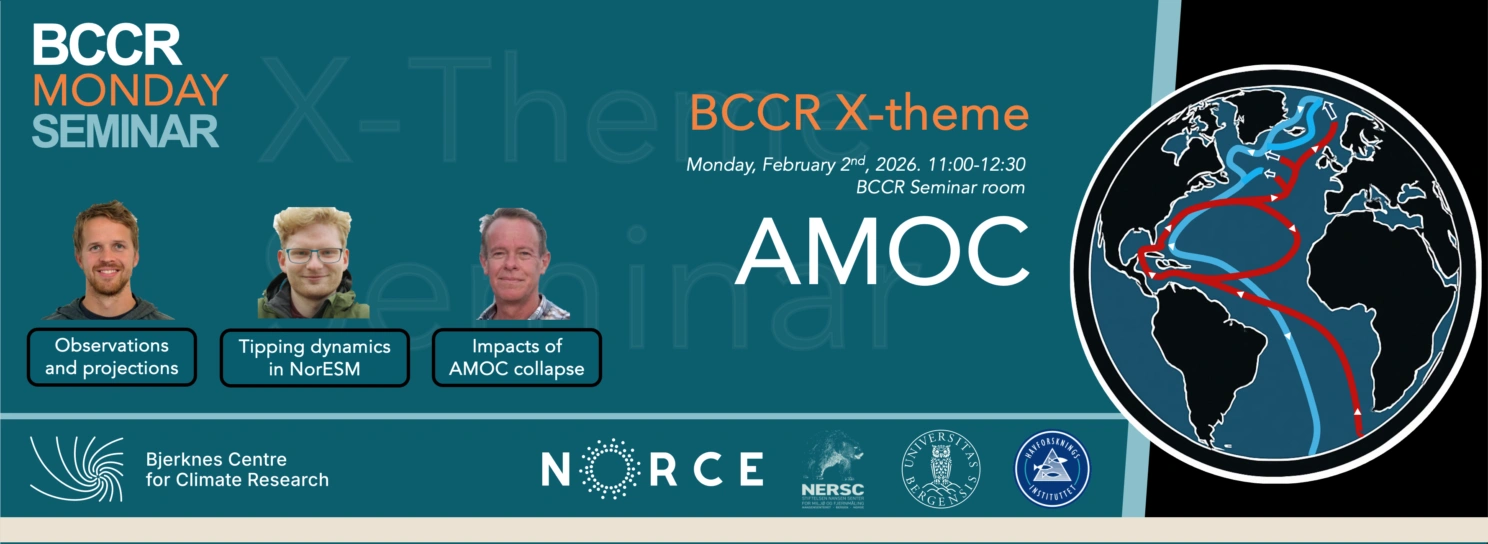
Hence, we are delighted to announce our monthly BCCR X-Theme seminar next week on Monday, February 2nd, at 11:00, with the title “AMOC”, presented by Marius Årthun, Malte Jürchott and Martin Miles.


Marius Årthun will present "Status observations and projections”.

Malte Jürchott will present “Analysing tipping dynamics of the AMOC in NorESM2 - current status and future plans”.

Martin Miles will present “Impacts of AMOC collapse”.


Following the three presentations, a general discussion about the topic will take place.


We hope to see you there!


Best regards,


Fiona and Johannes 
Flere kalenderoppføringer

Se alle
Illustrasjonsbilde
16.02.26

BCCR Monday Seminar: Robust Estimates of Earth System Predictability of the First Kind Using the CESM2 Multiyear Prediction System (CESM2-MP)

Abstract Here, we present a new seasonal-to-multiyear Earth prediction system, Community Earth System Model, version 2, multiyear prediction system (CESM2-MP), based on the CESM2. A 20-member ensemble that assimilates oceanic temperature and salinity anomalies provides the initial conditions for 5-yr predictions from 1960 to 2020. We analyze skills using pairwise ensemble statistics, calculated among individual members (IMs), and compare the results with those obtained from the more commonly used ensemble-mean (EM) approach. This comparison is motivated by the fact that an EM of a nonlinear dynamical system generates, unlike reality, a heavily smoothed trajectory, akin to the evolution of a slow manifold. However, for most autonomous nonlinear systems, the EM does not even represent a solution of the underlying physical equations, and it should therefore not be used as an estimate of the expected trajectory. The IM-based approach is less sensitive to ensemble size than EM-based skill computations, and its estimates of attainable prediction skills are closer to the actual skills. Using IM-based statistics helps to unravel the physics of predicted patterns in the CESM2-MP and their relationship to ocean–atmosphere–land interactions and climate modes of variability. Furthermore, the IM-based method emphasizes predictability of the first kind, which is associated with initial error sensitivity. In contrast, the EM-based method is more sensitive to the predictability of the second kind, which is associated with the external forcing and time-varying boundary conditions. Calculating IM-based skills for the CESM2-MP provides new insights into the sources of predictability originating from ocean initial conditions, helping to delineate and quantify the forecast limits of internal climate variability. Speaker information Yong-Yub is a new postdoctoral researcher at the Geophysical Institute at the University of Bergen. His research focuses on multiyear-to-centennial changes in marine biogeochemistry, the predictability of biogeochemical processes, and potential tipping points in the ocean system. He completed his PhD in Physical Oceanography at Seoul National University, where he used the ROMS regional ocean model to investigate future environmental changes in the East Asian marginal seas. He subsequently worked at the IBS Center for Climate Physics (ICCP), where he developed a multiyear prediction system based on CESM2 (CESM2-MP).
Illustrasjonsbilde
13.02.26

New at Bjerknes meeting

Information meeting for new members of the Bjerknes Centre. Contact the administration for invitation or information.