Jump to main content

Calendar

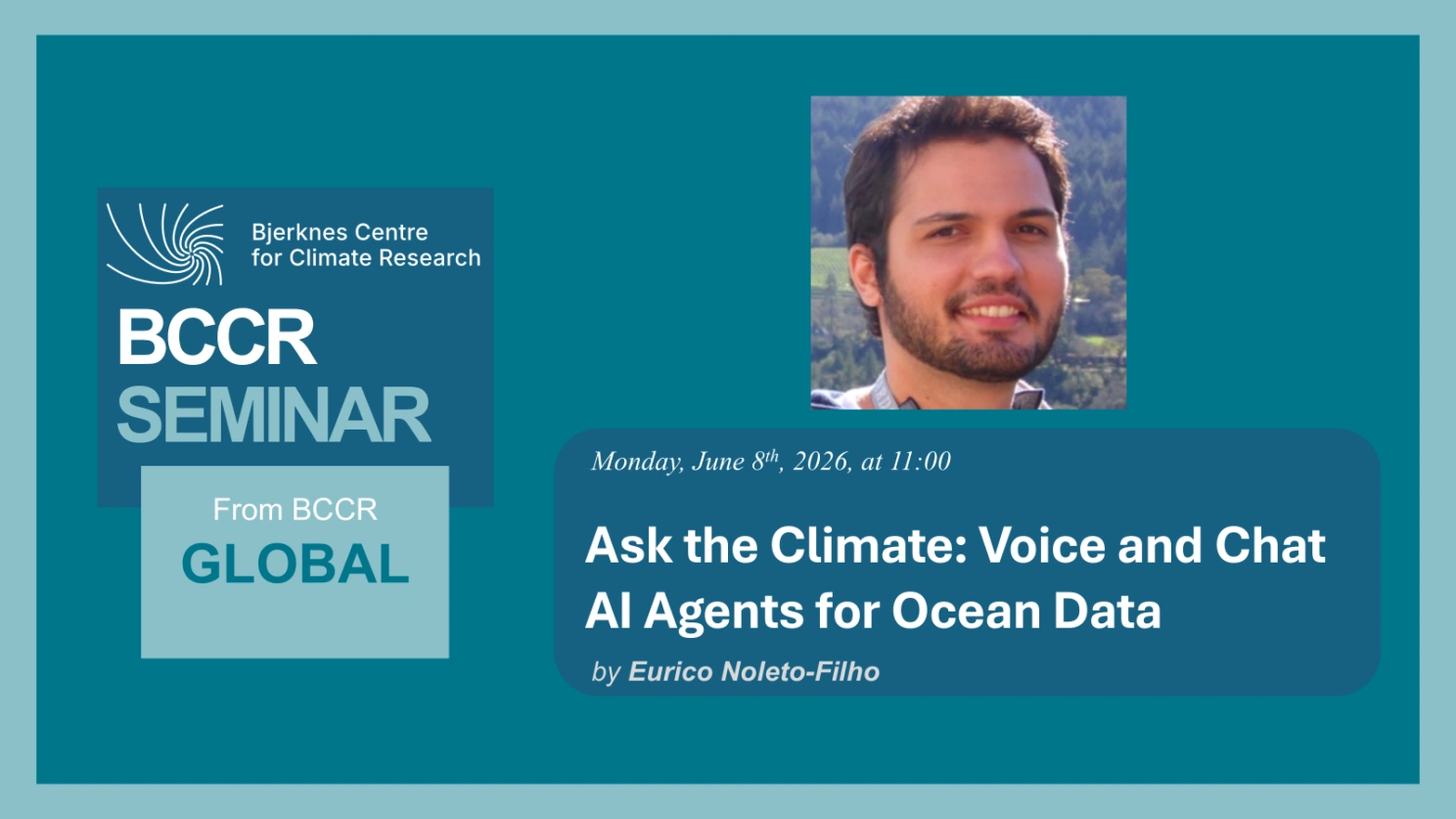
BCCR Seminar: "Ask the Climate: Voice and Chat AI Agents for Ocean Data”.
Time

08. June 2026, 09:00-10:00

Location

BCCR seminar room (4th floor of the West wing)

Dear all,


The next BCCR Monday Seminar will be given by Eurico Noleto-Filho from the Global group. He will present his work on "Ask the Climate: Voice and Chat AI Agents for Ocean Data”.

The seminar will take place in the usual BCCR seminar room (4th floor of the West wing) at 11:00.


We hope to see you there!


Best regards,


Fiona and Johannes


Abstract

Climate prediction models are powerful tools for projecting future environmental changes, yet their complexity (high-dimensional datasets, spatial maps, and probabilistic forecasts) makes them difficult to interpret for non-specialists. This limits meaningful engagement by researchers, policymakers, and the public, and constrains how climate information feeds into applied sectors such as fisheries and energy.
Recent advances in large language models (GPT-5.4, Claude Sonnet 4.2), real-time voice interfaces (OpenAI Realtime API), and agentic coding tools (Claude Code, OpenClaw) have reshaped what is possible in this field. These systems no longer simply describe model outputs; they actively query datasets, execute code, and reason over climate data in dialogue with the user. This shift has prompted us to rethink how LLMs can be embedded in climate model workflows, and how voice and chat modalities can broaden the reach of climate science.
In this talk, we present the latest advancements in our NorCPM-AI app, including new chat and voice agent features. We discuss the state of the art of these agentic and multimodal capabilities, their remaining limitations in numerical reasoning and uncertainty communication, and case studies linking NorCPM forecasts to fisheries and renewable energy.


Speaker information

I am a biologist with extensive experience in applying artificial intelligence, statistical modeling, and web application development to marine resource management initiatives (Blue Economy). My expertise includes Machine Learning, Hierarchical Bayesian Models, Spatiotemporal Models, and web app development, with proficiency in R and Python. I have strong programming skills and the ability to design innovative data analytics applications for governmental, corporate, and academic purposes. Additionally, I am the author of several web applications for marine resource data analytics, modeling, and forecasting.


Join Zoom Meeting 
https://uib.zoom.us/j/68304284910?pwd=2IgsDMWHuJlQw3XFHSTo3OoGBsRrhz.1

Meeting ID: 683 0428 4910
Password: 7pwZK4mG
More events

See all
Illustrasjonsbilde

Prøveforelesning over oppgitt emne for ph.d.-graden - MSc.- Jarle Børve Sleire
KUNNGJØRING PRØVEFORELESNING Institutt for geovitenskap Fakultet for naturvitenskap og teknologi Universitetet i Bergen Ph.d.-kandidat Jarle Børve Sleire holder prøveforelesning over følgende oppgitte emne for ph.d.-graden: Glacier retreat and emerging geohazards in a warming world Tid og sted: Fredag 13. november 2026, kl. 13.15 Auditorium 4, Realfagbygget Komité: Professor Kerim Hestnes Nisancioglu , Institutt for geovitenskap (leder for komiteen) Professor Henriette Linge, Institutt for geovitenskap Førsteamanuensis Chenliang Wu, Institutt for geovitenskap Adgang for interesserte tilhørere. VELKOMMEN!
Illustrasjonsbilde

Seminar: Giuseppe Tori – A Lagrangian view of the dynamics and organization of moist convection

Abstract Moist convection is organized across a wide range of scales, yet many of the processes that modulate it are difficult to quantify from an Eulerian perspective. In this talk, I will show how the coupling between a cloud-resolving model and a Lagrangian particle model can be used to address this limitation. Lagrangian particles are particularly useful because they can encode the history of air parcels. I will first discuss what this approach reveals about the dynamics of precipitation-driven downdrafts and cold pools--arguably one of the least understood components of moist convection--and about the mechanisms by which cold pools can trigger and organize new convective cells. I will then show how this framework can be extended to stable water isotopes. Because each particle carries its own isotopic composition, changes along its trajectory can be attributed to individual processes, such as rain evaporation, equilibration, mixing, and surface fluxes. This reveals, for example, that surface latent heat fluxes, rather than entrainment, control the isotopic composition of cold pools, and it provides a process-based foundation for interpreting isotope observations of convection. Finally, I will briefly discuss how this framework might be applied to marine cold-air outbreaks over the North Atlantic and Nordic Seas. Speaker information Giuseppe Torri is an Associate Professor of Atmospheric Sciences at the University of Hawaiʻi at Mānoa. His research focuses on the dynamics and organization of moist convection, with particular interests in precipitating convection, its interaction with larger-scale circulations and, more recently, the dynamics of extreme weather. Much of this work relies on the application of Lagrangian particle models and water isotopes to obtain a process-based understanding of atmospheric phenomena that are otherwise hard to quantify. He also studies island hydroclimates across a range of spatial and temporal scales. He trained as a theoretical physicist, receiving his PhD from Imperial College London, before moving into atmospheric science as a postdoctoral fellow at Harvard University.