The cod has followed the thermometer
In recent decades the cod stock in the Barents Sea has gone up and down with the ocean temperature. Future development depends on more than the water.
Publisert 09. December 2025
Written by Ellen Viste
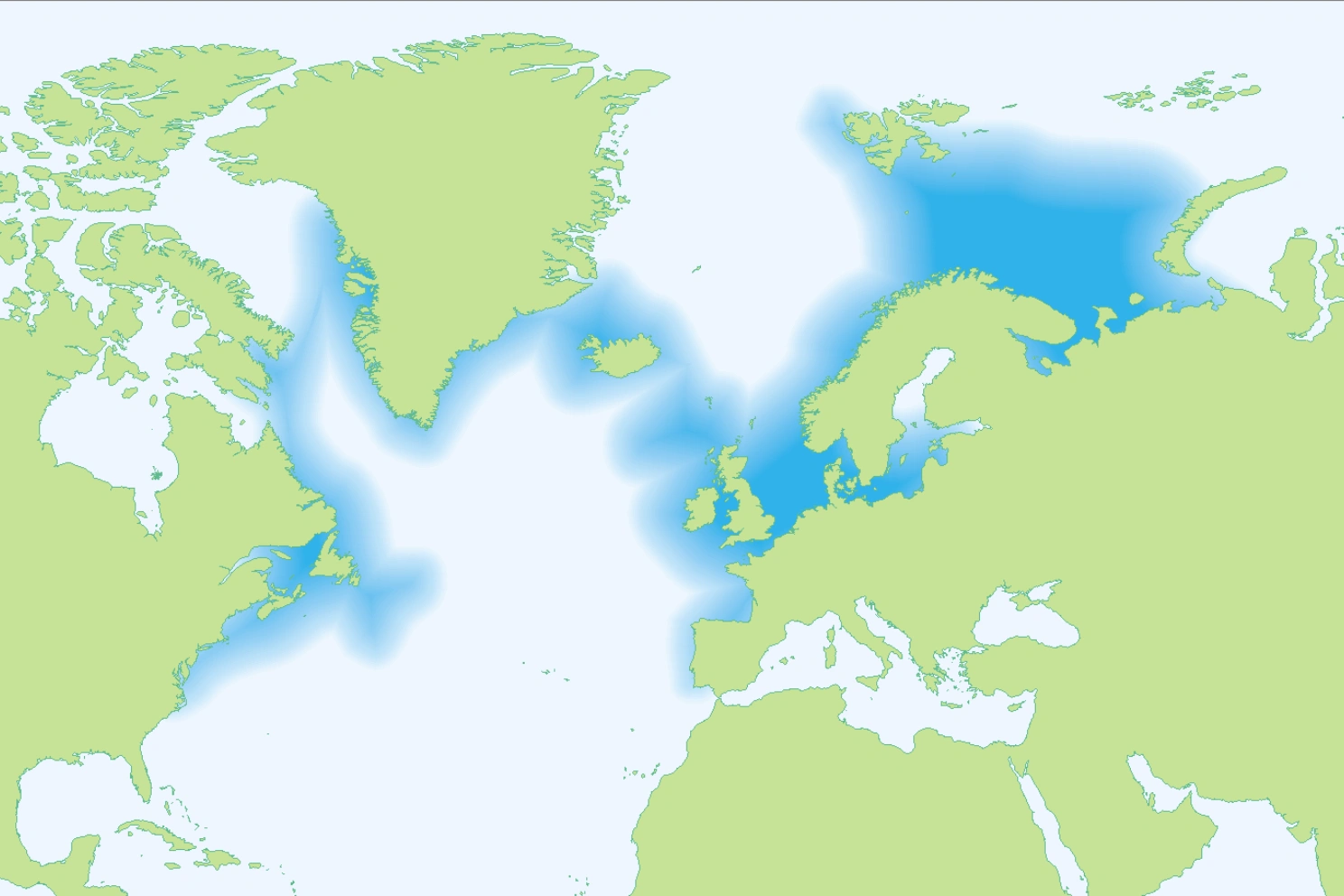
The Atlantic cod is found as far south as the Strait of Gibraltar and as far north as Svalbard. The stock in the Barents Sea spends most of its life there, only migrating to the Norwegian Sea for spawning. Ill.: Aotearoa, Creative Commons, lisens CC BY-SA 2.5
For more than a thousand years, Norwegians have fished cod, first near the coast in spring, and from the 1960s with sea-going trawlers all year round.
The cod that spawns in Lofoten, spends most of its life in the Barents Sea. Larvae drift there after spawning, the cod grows up there, and the mature individuals remain there, only interrupted by short migrations to the coast to spawn.
That is why the conditions in the Barents Sea are so important for Norwegian fisheries.
As early as 1909, oceanographers Bjørn Helland-Hansen and Fridtjof Nansen pictured the possibility of using temperatures in the Norwegian Sea to predict the development of fish stocks farther north. More recent research has confirmed their theory.
Cod thrive in warmer water
Warm and nutrient-rich water from the Gulf Stream crosses the Atlantic Ocean and flows northward along the coast of Norway. Heat from this water contributes to keeping southern parts of the Barents Sea ice-free throughout the winter.
Without ice, plankton and other organisms get more light and better conditions for growth, making the Barents Sea a productive region for fisheries.
In a recently published study, researchers from Bergen have compared the development in the cod population in the Barents Sea with the sea temperature, the ice cover and the salinity of the water during the last decades. Also, they considered the amount of zooplankton – food for cod larvae as well as for the small fish eaten by larger cod.
Their results show that variations in temperature and plankton can explain the major signature of the cod stock development.
More food
From the early 2000s till 2014 temperatures in the Barents Sea increased. At the same time the cod stock grew.
“More sea ice melted, there was more open water, and the cod could get a lot of food,” says oceanographer Mariko Koseki.
Koseki has led the new study as part of her work at the Bjerknes Centre, the Institute of Marine Research and the Geophysical Institute at the University of Bergen.
After 2014 the Barents Sea has cooled and the cod population decreased.
Future fisheries depend on more than temperature
Mariko Koseki and her colleagues found a statistical correlation between sea temperature, zooplankton and cod during the last decades.
They then used this relationship to estimate how the cod population may be expected to develop with different degrees of CO2 emissions and temperature rise in this century. The scenarios for the future climate were taken from climate models.
The researchers made predictions and projections for the biomass of cod in the Barents Sea, both for the coming decades and by the end of the century.
Disregarding other factors, higher sea temperatures provide better conditions for cod. Climate scenarios with higher CO2 emissions are associated with more cod in the Barents Sea. But temperature is not the only variable affecting fish in the sea.
“The cod biomass is also influenced by human activities like fishing,” says Mariko Koseki. “And by the fish itself. They do not eat only zooplankton.”
Cod eat whatever they find – small copepods at the larval stage, then bigger copepods and later fish and benthic organisms. Variations in the capelin population strongly affect the cod population.
A first step
Anne Britt Sandø is a researcher at the Institute for Marine Research and the Bjerknes Centre and has also contributed to the new study. She emphasizes that the predictions of future cod biomass are highly uncertain.
“Whether there will be sufficient suitable food, and if spawning grounds may shift northward and larvae drift into regions with harsher conditions, are important questions,” she says.
Fishing quotas are mainly shared between Norway and Russia. Each year, quotas are allocated following a principle that thirty percent of the cod that is at least three years old, can be harvested.
So far, researchers have estimated variations in the total biomass of cod in the Barents Sea, not the distribution of fish by size or year class. Sandø notes that the mass of cod can develop differently than the number fish large enough to be caught.
Mariko Koseki imagines that future predictions of the cod population may include factors such as fisheries.
“This is a first step,” she says.
References
Exploration of short-term predictions and long-term projections of Barents Sea cod biomass using statistical methods on data from dynamical models
Climate based multi-year predictions of the Barents Sea cod stock