Looking at freshwater in a new way
Freshwater is quietly reshaping the oceans — and with it, the climate. A new study has looked at how rain, river runoff, and melting sea ice spread through the world’s oceans, revealing differences between the Arctic and Antarctic.
Publisert 09. December 2025
Written by Tori Pedersen

Dávilas research is focused on the role of the ocean`s large scale circulation on the distribution of seawater properties, with a special focus on climate. Photo: Tori Pedersen / Bjerknes Centre
The study combined global data to estimate how much of each type of freshwater is present in different parts of the ocean.
“The idea behind the study was mostly to take advantage of all the data that exists for the oxygen isotopes measured in seawater, because it is a great tracer for freshwater. Our team wanted to trace or quantify the freshwater budget in the polar water masses and their role in the global ocean circulation”, says Xabier Dávila from NORCE and the Bjerknes Centre for Climate Research.
A freshwater budget is an accounting system that tracks the different sources that make the ocean fresher, namely precipitation or sea ice meltwater. While salinity just tells you “how fresh” the ocean is, oxygen isotopes in seawater can split between the two sources that contribute to that “freshness”. In this way, you can understand how different sources change over time.
Trace freshwater
Freshwater in the ocean affects stratification and can affect deep convection and other processes in the ocean because it changes the density and structure of the ocean. If you know where the fresh water is coming from, it is easier to both predict but also understand the changes.
The main challenge in the study is to find the isotopic signature in precipitation, before it mixes with the ambient ocean seawater. You need this original signature to build a mixing model and calculate the contribution of each freshwater source.
“There are very few measurements of oxygen isotopes in precipitation taken just above the ocean, and in addition it largely varies latitudinally as atmospheric moisture is distilled in the atmosphere when travelling to polar regions”, says Dávila.
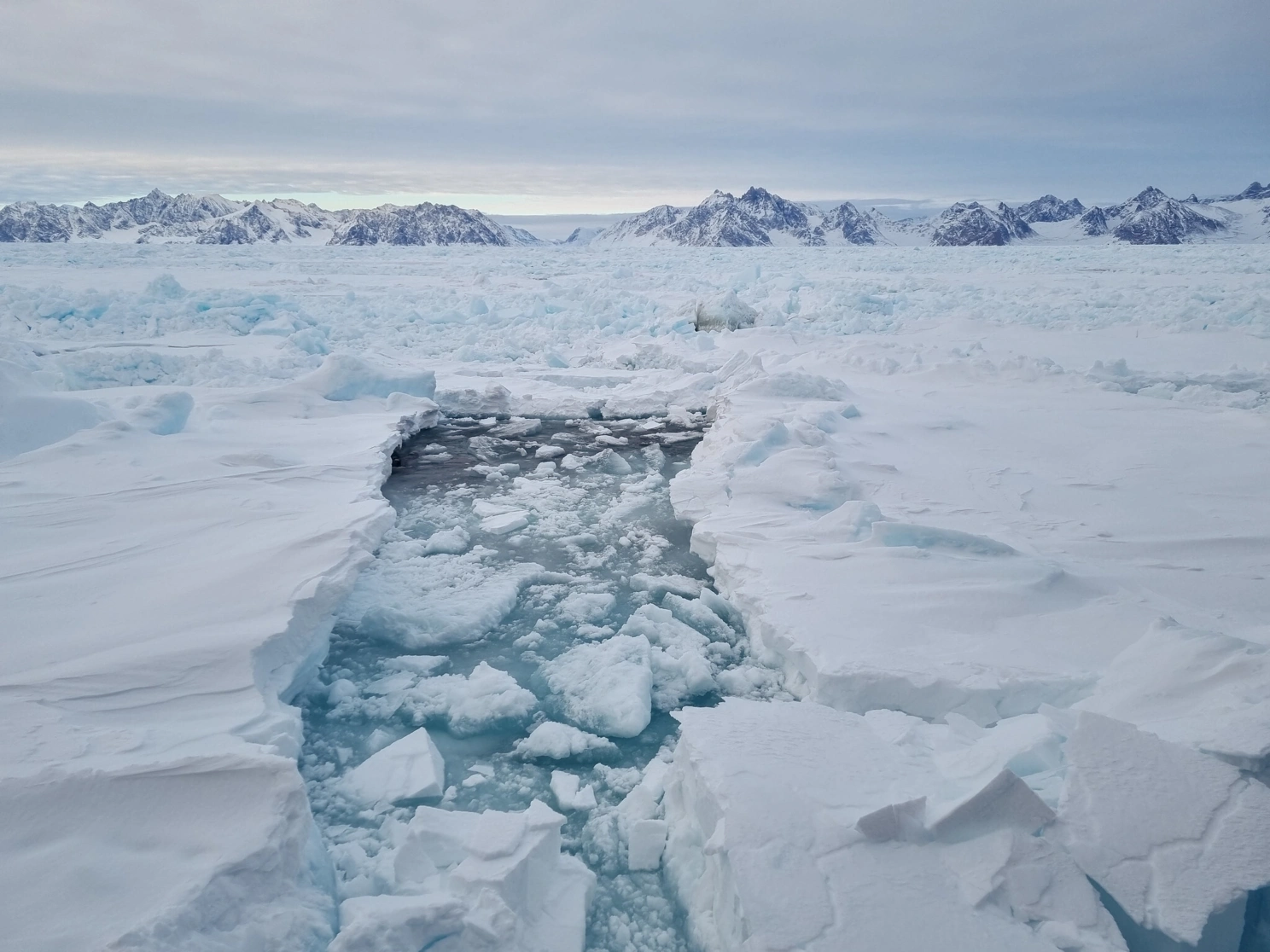
The results highlights the asymmetry between the dense water formation processes in Antarctic and Arctic. Photo: Ellen Viste / Bjerknes Centre
Antarctic bottom water is freshening
They used a machine learning method called Self-Organizing Map, which finds relationships among data points. Then they applied this to ocean temperature, salinity and seawater oxygen isotopes to group the data according to different “types” of water masses. This allows researchers to infer the isotopic signature of precipitation when it fell over the ocean and to build the mixing model between ocean, precipitation and sea ice meltwater.
Their research provides the first evidence, based on oxygen isotopes, that Antarctic bottom water is freshening, not because of more glacier melting, but because of reduced sea ice formation. Sea ice formation increases salinity, while melting makes the ocean fresher – and showcases the key role of sea ice in forming dense waters in Antarctica.
Ocean asymmetry
In contrast, in the Arctic, sea ice does not partake in forming dense waters, and freshening driven by sea ice melting takes place at the surface, which is an expected signal resulting from climate change.
“These results highlight the asymmetry between the dense water formation processes in Antarctic and Arctic and how they shape global ocean circulation”, Dávila says.
The approach shows that there are detectable signals in deep-water measurements that can reveal past processes. Dávila’s next study is to use these signals together with ocean circulation models to trace water masses back in time.
“This can allow scientists to reconstruct past surface salinity and other conditions, improving our understanding of historical ocean changes”, he says.
References
Freshwater Sources in the Global Ocean Through Salinity-δ18O Relationships: A Machine Learning Solution to a Water Mass Problem