The Bjerknes Year 2025
A new year stands at the doorstep. While we wait for all things new, lets take a moment to look back at the year that was.
Publisert 29. December 2025
Written by Thea Svensson
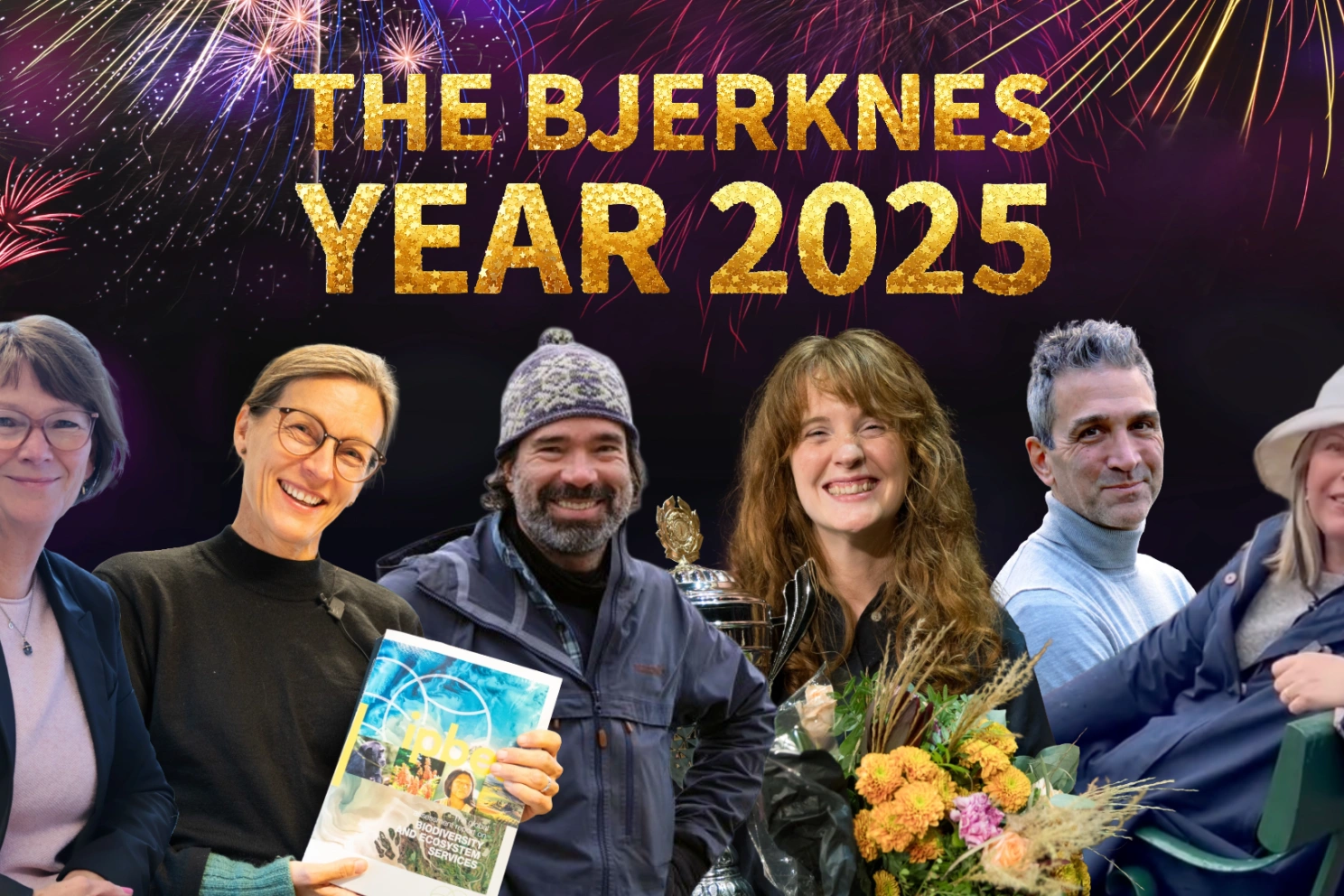
Much has happened here at the Bjerknes Centre in 2025. We welcomed a new leader and deputy leader for Climate Hazards, Stijn De Schepper and Mari Fjalstad Jensen. Several "Bjerknesians" also took on important roles and positions. Among them, Lars Henrik Smedsrud became the new Marine Dean at the University of Bergen, and Lise Øvreås became the new president of EASAC (European Academies’ Science Advisory Council). Furthermore, research leader Stefan Sobolowski was selected as a lead author for the IPCC Special Report on Cities, and Rebekka Frøystad took home the victory at the Researcher Grand Prix in Bergen.
In addition, we celebrated our 25th anniversary. Many from both inside and outside the Bjerknes Centre gathered in March for the event "Regn med oss" (Count on us/Rain with us), which took place at Grand selskapslokaler at Ole Bullsplass on March 14th.
25 Years of Excellence in Research
The year 2025 marked 25 years since the Bjerknes Centre was established. In the time since, it has grown to become one of Europe's largest natural science climate research centers. In the year 2000, the Bjerknes Centre was awarded "Centre of Excellence" (SFF) status by the Research Council of Norway, and in 2012, the center was evaluated as "exceptionally good" by an international committee. Today, the Bjerknes Centre is a large interdisciplinary research hub with 300 researchers from 40 countries, distributed across our four partners: NORCE, the Nansen Center, the University of Bergen, and the Institute of Marine Research.
The Arctic Ocean 2050
In 2025, the government granted one billion NOK over ten years to the research program Arctic Ocean 2050. This is a major ten-year research project running from 2026–2036, involving the full breadth of relevant research environments and gathering polar researchers from 18 Norwegian universities and institutes. All four partners of the Bjerknes Centre—the Institute of Marine Research, the Nansen Center, NORCE, and UiB—are participants.
The program will cover fields from the deepest ocean floors to the upper atmosphere. Throughout the ten-year period, Arctic Ocean 2050 will ensure a long-term and active presence in Arctic waters by a large number of Norwegian institutions.
At the Bjerknes Centre, we are particularly proud of two of our research leaders, Are Olsen and Marius Årthun, who led the development of the research plan underlying the project.
- Understanding the Arctic is crucial for a safe Norway. Norway is NATO's eyes and ears in the North, and many countries wish to cooperate with us on the research happening there. Major changes are underway in the Arctic, ranging from climate, ocean, and nature to defense and security. Therefore, it is vital that Norway remains at the forefront of Arctic research, said Prime Minister Jonas Gahr Støre during the launch.
Mountains in Motion
On May 28, 2025, a massive landslide occurred in the village of Blatten in Switzerland, which was buried under tons of earth, ice, and water. Thanks to early warning systems, all residents were evacuated, and though many lost their homes, no lives were lost. This served as a vital reminder of how crucial it is to monitor mountain movements.
Mountains worldwide are changing, including here in Norway. To map the interaction between mountains and climate, a new mountain center opened in May, led by Jostein Bakke at the Department of Earth Science at the University of Bergen and the Bjerknes Centre.
The center's international name is the Scandinavian Centre for Mountains in Transition (SMT). The Trond Mohn Research Foundation supports the initiative with 20 million NOK over four years, with UiB providing a matching amount.
The Global Carbon Budget
In November, the Global Carbon Budget was published during the climate summit in Brazil. The carbon budget for 2025 estimated global CO₂ emissions at 38.1 billion tonnes. Several researchers from the University of Bergen, NORCE, and the Bjerknes Centre provided vast amounts of data on the state of the world's oceans through both observations and models. The new estimates show that the ocean has absorbed 29% of total emissions over the last decade, compared to 26% in previous budgets.
One of the researchers working on ocean uptake was Abdir Omar of NORCE and the Bjerknes Centre.
- Based on new evidence from field and modeling studies, the current budget includes observation-based CO2 data products which have been corrected to the temperature of the skin layer (where the gas exchange takes place) instead of the traditionally used, slightly warmer, bulk sea surface temperature, says Abdir.
From IPBES to IPCC
— It is a great honor, but I also feel a sense of awe. We are going to synthesize knowledge across a massive field that is developing very rapidly. One characteristic of nature is that it is highly variable, and the effects of climate change also vary between species, habitat types, and regions. We must summarize all of this in a way that makes the results understandable and useful for decision-makers, says Vandvik in an article published earlier this year.
More than 600 experts from 111 countries are participating in writing the report. The scientific assessments from the IPCC form the foundation for global climate negotiations under the UN Climate Convention. The Seventh Assessment Report is expected in 2028 and/or 2029.
An Uncertain Climate Landscape
The climate is constantly changing, as is our ability to observe, research, and understand these changes. On the other side of the Atlantic, climate research has faced major challenges, and research institutions that laid the groundwork for much of modern climate science are under threat. Among other developments, the Trump administration recently decided that the U.S. National Center for Atmospheric Research (NCAR) will be closed.
This comes at a time when the highest levels of atmospheric CO₂ concentration since measurements began in 1958 have been recorded. In an article published on May 16, the Bjerknes Centre reported that the Mauna Loa station in Hawaii showed over 430 ppm since the beginning of May 2025. In 67 years, global CO₂ levels have risen by 117 ppm.
— "I was born in 1969, into a 324 ppm world, and last year, in 2024, 424 ppm was measured at Mauna Loa for the first time. 100 ppm in 55 years! It is completely outside the natural scale and variability. It is a frightening anniversary. Every month, I adjust the CO₂ figure in my slide decks. The changes and the rise are happening faster and faster," says Kikki Kleiven, Director of the Bjerknes Centre for Climate Research, in the article.
New Doctoral Degrees
In 2025, 12 Bjerknesians completed their doctoral work. A PhD is the end of a long and demanding journey in academia, and we offer many congratulations and best wishes to everyone.
January
Ashbin Jaison: "StormRisk: Linking Norwegian windstorms and damage, future risk and the feasibility of impact based forecasting".
Anna Marie Strehl: "Long-term changes in stratification and convection in the Nordic Seas".
February
Omar El Guernaoui: "Scaling non-stationary turbulence during the afternoon and evening transition of the convective boundary layer".
April
Andrew Walter Seidl: "Profiling the stable isotope signature of water vapour from kinetic fractionation in Arctic conditions".
Marine Røysted Solås: "Vertical distribution of mesopelagic organisms under changing oxygen conditions: Insights from western Norwegian fjords".
May
Inès Ollivier: "Impact of Surface Processes on the Antarctic Water Isotope Climate Signal".
October
Daniel Gunning: «Modelling the Pleistocene Climate Cycles: Assessing the Roles of Precession and Obliquity»
Waynee Wong: "Sea ice in the Nordic Seas during Dansgaard-Oeschger events".
November
Mathias Venning: "Enacting a Global Vision for Climate Services"
December
Charlotte Rahlves: "Improving Greenland ice sheet projections across timescales".
Johannes Hardeng: «Floods and avalanches in a changing climate: Reconstructing frequency and seasonality from lacustrine records in southern Norway»
Karl Guy Romeo Purcell: "Reconstructions of southern South Africa hydroclimate during the last glacial cycle, and potential linkages to human behavioural development
Projects 2025
Researchers affiliated with the Bjerknes Centre took part in several projects that started in 2025. Here is an overview of a selected few:
TRICUSO: Led by Richard Sanders (NORCE and Bjerknes Centre). The goal is to obtain new CO₂ data in the Southern Ocean, a vital but poorly mapped carbon sink, using new observation platforms like racing sailboats and autonomous vehicles. Funded by the EU.
TipESM - Exploring tippping points in the Earth System with ESMs: Though it started in 2024, we include it as it gained significant momentum this year. A large EU project where Friederike Fröb plays an important role investigating various tipping points.
NAVIGATE - Navigating the uncharted territory of the Anthropocene climate: Led by Jerry Tjiputra (NORCE, Bjerknes Centre). The goal is to examine how different "Climate intervention" measures can (or cannot) help meet the goals of the Paris Agreement.
BioGeoSea - Enhancing Biogeochemical Essential Ocean Variables for European and Global Assessments: A new EU-funded project coordinated by GEOMAR. Jöran März is involved, studying transparent exopolymer particles (TEP), sticky sugar-like molecules that play a key role in transporting carbon to the deep ocean.
SeaClim - European SEAs CLIMate impact prediction through regional models: A new EU-funded project aimed at providing better predictions for coastal waters regarding both physical and biogeochemical conditions, contributing to the "Digital Twin of the Oceans." Filippa Fransner and Annette Samuelsen are participants.
Publications
Collectively, researchers affiliated with the Bjerknes Centre publish hundreds of papers every year. Here is a selection; the full list can be found on the Bjerknes Centre website.
Marine ecosystem role in setting up preindustrial and future climate
Tjiputra, J. F., Couespel, D., & Sanders, R. (2025). Marine ecosystem role in setting up preindustrial and future climate. Nature Communications, 16(1), 1–8. https://doi.org/10.1038/s41467-025-57371-y
Mapping the safe operating space of marine ecosystems under contrasting emission pathways
Bourgeois, T., Tran, G. T., Jeltsch-Thömmes, A., Schwinger, J., Fröb, F., Frölicher, T. L., Blenckner, T., Torres, O., Negrel, J., Keller, D. P., Oschlies, A., Bopp, L., and Joos, F.: Mapping the safe operating space of marine ecosystems under contrasting emission pathways, Biogeosciences, 22, 5435–5462, https://doi.org/10.5194/bg-22-5435-2025, 2025.
Warming and freshening coastal waters impact harmful algal bloom frequency in high latitudes
Silva, E., Counillon, F., Brajard, J. et al. Warming and freshening coastal waters impact harmful algal bloom frequency in high latitudes. Commun Earth Environ 6, 445 (2025). https://doi.org/10.1038/s43247-025-02421-y
Halbritter, A. H., J. Atkinson, C. Maré, et al. 2025. “ Effects of Warming, Nitrogen and Grazing on Plant Functional Traits Differ Between Alpine and Sub-Alpine Grasslands.” Journal of Vegetation Science 36, no. 5: e70061. https://doi.org/10.1111/jvs.70061.