Calendar
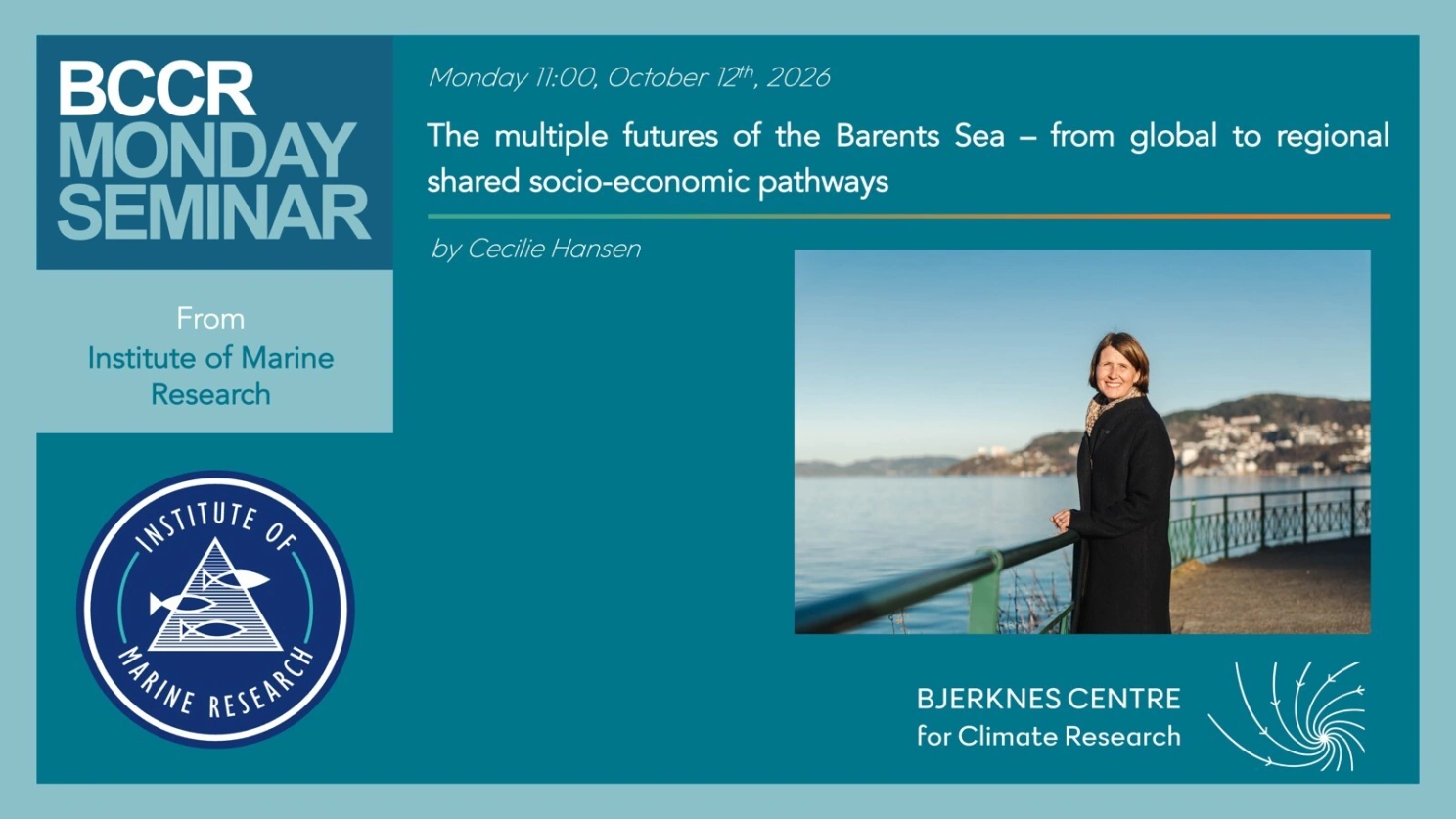
The multiple futures of the Barents Sea – from global to regional shared socio-economic pathways
Time
12. October 2026, 09:00-10:00
Location
BCCR Seminar Room – 4020
Abstract
The shared socio-economic pathways (SSPs) developed by the intergovernmental panel on climate change (IPCC) are formulated as broad, archetypal pathways the world might follow into the future. They provide information about possible human and ecological trajectories on global scale yet lack region-specific details that are important for scenario development to support policy and management at national and regional levels.
Here, we consider four of the five SSPs (SSP1-nature first, SSP3 – regional rivalry, SSP4 – inequality and SSP5-world markets) and explore their implications for the Barents Sea region at the horizon of 2100. We focus on maritime sectors of particular relevance to the region: fisheries, shipping, defence, renewable energy, environmental protection, tourism, and oil and gas. We construct storylines describing the regional development of each of these sectors along the four archetypal SSPs. We then present the completed regional pathways to stakeholders representing each of the sectors, to collect feedback and make revisions where necessary. These regionalised SSPs provide a potential test-ground for future scenarios through planned ecosystem modelling.
This regionalised analysis reveals that the geopolitical situation is a critical uncertainty with potentially large implications on the other marine sectors in the future. In addition, global targets such as reaching 30x30 (protecting 30% of marine areas by 2030) have potential large-scale impact on area-demanding sectors, such as fisheries, and in particular bottom trawling. The pathways presented here are suggested as a starting point for further discussions on possible future trajectories in the Barents Sea.
Speaker information
Cecilie Hansen is an ecosystem modeler and research professor at the Institute of Marine Research (HI). She has worked with different modelling frameworks – from simple phytoplankton models to complex ‘whole world’ models – with a focus on overall impacts from anthropogenic activities, including climate change, in the Nordic and Barents Seas .
More events
See all
Stormtracks group meeting
