Jump to main content

Calendar

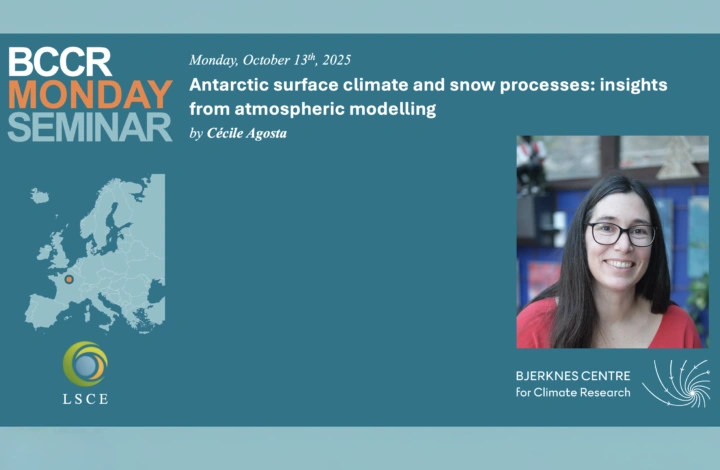
Monday seminar - Cécile Agosta - Antarctic surface climate and snow processes: insights from atmospheric modeling
Time

13. October 2025, 12:30-13:15

Location

Room 4020

The next BCCR Monday Seminar will be given by Cécile Agosta from Laboratoire des Sciences du Climat et de l’Environnement.  She will present her work on "Antarctic surface climate and snow processes: insights from atmospheric modeling". The seminar will take place in the usual BCCR seminar room (4th floor of the West wing) at 14:30.

Abstract

The amount of snow that accumulates on top of the Antarctic ice sheet represents a large flux, of the same order of magnitude as the current sea level rise. In this presentation, I will discuss the atmospheric water cycle in Antarctica, describe it within the context of the general circulation, and highlight the specific characteristics associated with the large ice sheet. I will then show that, at first order, physical parameterizations in atmospheric models are more important than model resolution for accurately simulating the Antarctic surface climate. For illustration, I will focus on Antarctic snow accumulation and the sublimation of precipitation within the atmospheric column. Finally, I will outline our ongoing efforts to further improve the LMDZ global atmospheric model over ice sheets, with an emphasis on snow modelling, air–snow exchanges, and cloud processes, in conjunction with constraints from water isotopes.

Speaker information

I am a senior researcher at the Laboratoire des Sciences du Climat et de l’Environnement (LSCE, Paris-Saclay), working on the Antarctic climate from an atmospheric point of view. I earned my PhD in 2012 at the University of Grenoble, France, where I studied the impact of topography on the Antarctic snow accumulation. I then spent five years at the University of Liège, Belgium, continuing to investigate the Antarctic water cycle while using and further developing the regional atmospheric model MAR. Since 2018, I have been a research fellow at the LSCE, where I study air-snow exchanges in Antarctica, including water isotopes, and contribute to improving their representation in both global and regional configurations of the LMDZ atmospheric model.

Zoom details https://uib.zoom.us/j/62554083320

Password: bScc54hk!


We hope to see you there! 

Best regards,

Julia and Robin

More events

See all

Illustrasjonsbilde
09.03.26

BCCR Monday Seminar: “Decadal prediction for the energy sector”

Dear all, The next BCCR Monday Seminar will be given by Ben Hutchins from the University of Reading. He will present his work on “Decadal prediction for the energy sector”. The seminar will take place in the usual BCCR seminar room (4th floor of the West wing) at 11:00. We hope to see you there! Best regards, Fiona and Johannes Abstract The timescale of decadal climate predictions, from a year-ahead up to a decade, is an important planning horizon for stakeholders in the energy sector. With power systems transitioning towards a greater share of renewables, these systems become more vulnerable to the impacts of both climate variability and climate change. As decadal predictions sample both the internal variability of the climate and the externally forced response, these forecasts can provide useful information for the upcoming decade. There are two main ways in which decadal predictions can benefit the energy sector. Firstly, they can be used to try to predict how a variable of interest, such as average temperature, may evolve over the coming year or decade. Secondly, a large ensemble of decadal predictions can be aggregated into a large synthetic event set to explore physically plausible extremes, such as winter wind droughts. We find predictive skill at decadal timescales for surface variables over Europe during both winter (ONDJFM) and summer (AMJJAS). Although this skill is patchy, there are regions of relevance to the energy sector, such as over the UK for temperature, where this skill emerges. We find significant skill when using pattern-based (e.g., NAO) approaches to make predictions of European energy indicators during the extended winter, including Northern Europe offshore wind generation, Spanish solar generation, and Scandinavian precipitation. Our results highlight the potential for operational decadal predictions for the energy system, with potential benefits for both the planning and operation of the future power system. Speaker information Ben is a PhD student at the University of Reading, exploring the applications of decadal forecasts for the energy sector. He is currently working as a Research Scientist for the National Centre for Atmospheric Science on the WISTERIA project, exploring the prediction skill for wind speed over Asia. Ben has previously worked part-time for the Royal Meteorological Society as their Science Engagement Fellow for Energy and has worked on the development of the annual 'State of the Climate for the UK Energy Sector' report.
Illustrasjonsbilde
04.03.26

Stormtracks Group Meeting

We’ll have our Stormtracks group meeting this Wednesday (04.03) from 14:00 to 15:00 at Skybar (BCCR 3180). This week Sigrid Galtvik will give a talk on Frontogenesis of stationary and propagating vortices. The meeting will be hybrid and you can join remotely via Zoom: https://uib.zoom.us/j/62886269543?pwd=ajWbi97zr0hbniaoQdZkUtD2EUSSri.1 Meeting ID: 628 8626 9543 | Password: qSKTfKU3 The meeting schedule for this semester is in the following google doc and there are still open spots! Any ongoing results are also very welcomed and encouraged just add your name directly to the schedule: https://docs.google.com/document/d/1F9hy45DSeS9qrXl-3l4cNzCPSE9OuBBVqdCu3VY240U/edit?usp=sharing See you all there! :) Cheers, Birgit and Yangfan